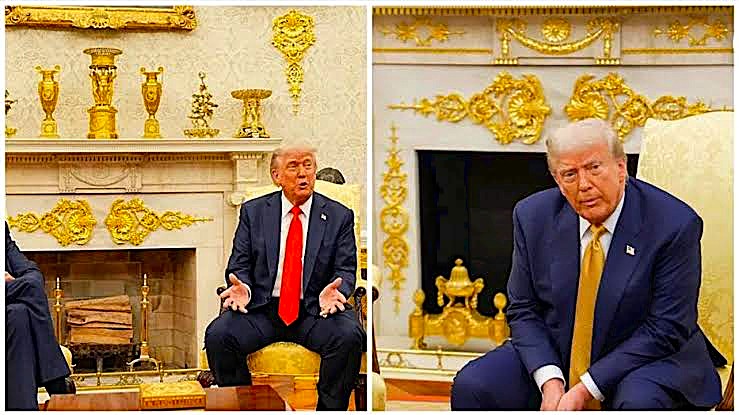
When I see Trump receiving guests in front of the fireplace in the Oval Office, I cannot help but feel that, he is reflecting his own insecurity trough those carefully staged surroundings, Trump has cultivated an atmosphere that obviously is intended to project opulence and a sense of security derived from power and wealth, but which, in reality, becomes a pathetic act of self-disclosure. Trump’s fixation on interior design serves as an illustration of the American president’s inner emptiness; he has fashioned himself as a product — a brand. The human being behind Trump is no longer to be found.
As soon as he had moved into the White House, Trump ordered extensive changes, not to make the place more pleasant and welcoming, but to reflect his own skewed conception of what taste and style entail.
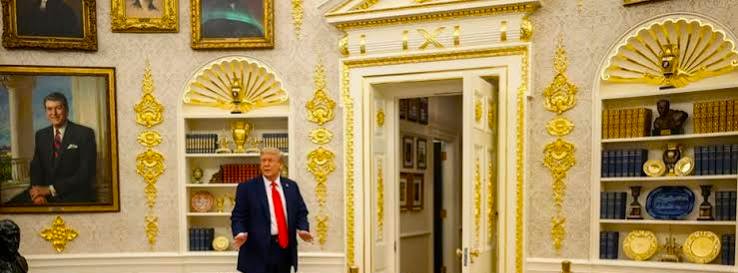
Fitted with gold and marble, just like the other places where Donald J. Trump resides – his penthouse in Trump Tower, the resort in Mar-a-Lago – where the glass, gold, and marble dominate in all their opulence. The impression is almost blinding and undeniable vulgar.
.jpg)
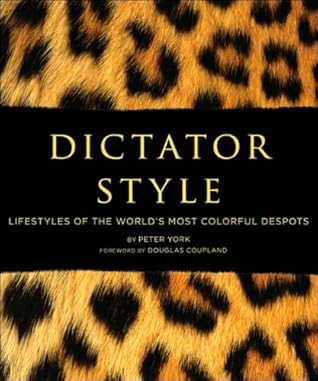
To a surprisingly high degree, Trump’s taste aligns well with the criteria presented by style guru Peter York in his 2005 book, Dictator Style: Lifestyles of the World’s Most Colourful Despots. A few examples:
a) “Old, classic style” conveys a sense of seriousness, especially if it incorporates an abundance of gold and intricate detailing. Since authentic antiques might appear to be overly stiff and uncomfortable, opt instead for new artefacts designed in a style that appears to be aged, though well-established as tasteful, widely recognized, and not too daring.
b) If you are accordingly opting for “period-style” furniture and elaborate ornamentation, it should ideally be “French” in character meaning you have to avoid the sombre, heavy and rustic impression often associated with English or German styles. By “French, is meant curved fireplace mantels, chairs with oval backrests, ornate plasterwork, extensive gilding, and heavy chiffonniers (tall chests) adorned with gilt-bronze mounts.
c) Think in terms of a luxury hotel. For an ambitious man with uncertain taste, a venue like the Grand Hôtel becomes the ultimate embodiment of luxury and prestige.
d) Gold – as much as possible must be gilded and gleaming.
e) An abundance of glass, windows, and mirrors and of course, crystal chandeliers; these are the diamonds of interior décor – opulent and radiant.
f) “Refined” paintings executed in an impeccable, realistic style, and absolutely no abstract art. Imposing self-portraits are particularly encouraged.
g) Established brand names apply to the choice of artists as well; they should be highly regarded among both ancient and nouveau riche, ideally with ties to nobility and/or royal houses.
h) Marble galore is essential. Use as much marble as possible; it does not have to be patinated or muted, it’s better if it’s gleaming white and guaranteed authentic.
i) Maintain a constant presence. Through your interior design and portraits, you must emphasize that you are the master of your surroundings, ideally by invoking a long-established tradition, or in the absence of such, by displaying visible power and potency.
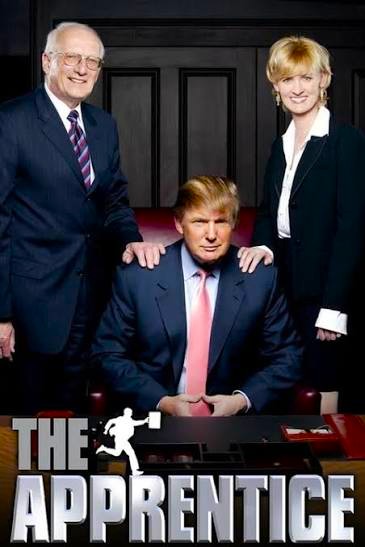
However, it does not appear as if Trump’s extravagant interior design taste has followed him throughout his life. Twenty years after the reality TV series The Apprentice became a hit in the United States, paving the way for Trump to the White House. one of the series four producers, Bill Pruitt, published in the online magazine Slate, a scathing account of Trump’s involvement in the show.
Pruitt described how the series elevated Donald J. Trump from being a “sleazy New York tabloid hustler” to earn a respectable reputation as a man of impeccable business instincts and possessor of unparalleled wealth. This despite the fact that his companies had barely survived multiple bankruptcies, and that he was facing yet another financial catastrophe at the time the TV series came to his rescue.
By misleading viewers, the show crafted an idealized image of Trump – his wealth, status, character, and intentions. The deceptively competitive reality series initiated a rehabilitation of the dubious Trump and it ultimately exceeded the wildest imaginings of its creators.
The Apprentice, Intro Season 1, Donald Trump

Pruitt recounted how the show’s producers were forced to edit every episode due to Trump’s inability to concentrate, to remember scripted lines in advance, and/or to recall the names of the participants, difficulties compounded by his tendency to occasionally blurt out highly inappropriate, misogynistic and racist remarks and opinions.
While filming, he struggled to convey even the most basic items. He could barely put a sentence together regarding how a task would work.
Much like Tony Schwartz, Trump’s “ghostwriter,” who practically single-handedly penned the potentate’s hit book The Art of the Deal, Pruitt came to regret having helped craft an image of Trump that bore little resemblance to the rather tawdry reality.
While much could be said about Trump’s greed and fraudulent dealings, let us stick to the aesthetics. Pruitt wrote that The Apprentice was based on a concept developed by an Englishman named James Burnett. The premise required finding a millionaire willing to serve as a role model and judge for a group of handpicked contestants, motivated individuals prepared to take part in a spectacle centred on fierce competition, where the ultimate prize was USD 250,000 and the prospect of being mentored by the very mogul who had evaluated the participants’ business acumen.
Finding a suitable candidate — someone capable of acting as an authoritative judge and mentor — proved to be quite difficult. Trump was one of several options, and perhaps not the most sought-after choice for hosting the show. Even he was initially hesitant about the whole endeavour, while declaring that: ”Reality TV is for the bottom-layer of society.” However, Trump had suffered several severe financial setbacks and begun to realize that it would be better to build a name for himself through self-promotional propaganda, and subsequently license his name to others than to take on debt to cover his substantial development costs. In a showbusiness obsessed country like the US there is no greater asset than celebrity. To be famous is to be loved – or at least fawned over.
Once James Burnett grasped this, he managed to convince Trump that The Apprentice would portray him as a successful businessman with a luxurious lifestyle and thereby make his name worth its weight in gold. Trump took the bait.
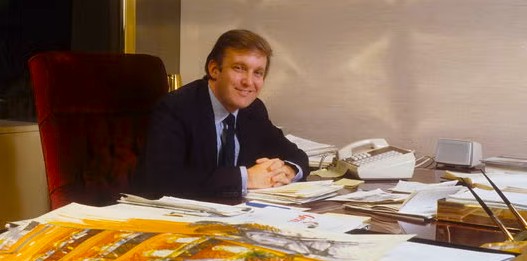
Trump was to play the role of himself, i.e. a successful businessman, though creating an illusion that would appeal to a wide audience required an impressive setting. Pruitt described the shock he and his fellow producers felt when they visited Trump’s office. They were met by a “stench” that permeated the upper floors of the Manhattan skyscraper where Trump worked. The carpets had an unbearable musty smell and Trump’s desk was cluttered, worn, and chipped.
When you go into the office and you're hearing 'billionaire,' even 'recovering billionaire,' you don't expect to see chipped furniture, you don't expect to smell a carpet that needs to be refreshed in the worst, worst way. […] The whole thing was absurd to all of us.
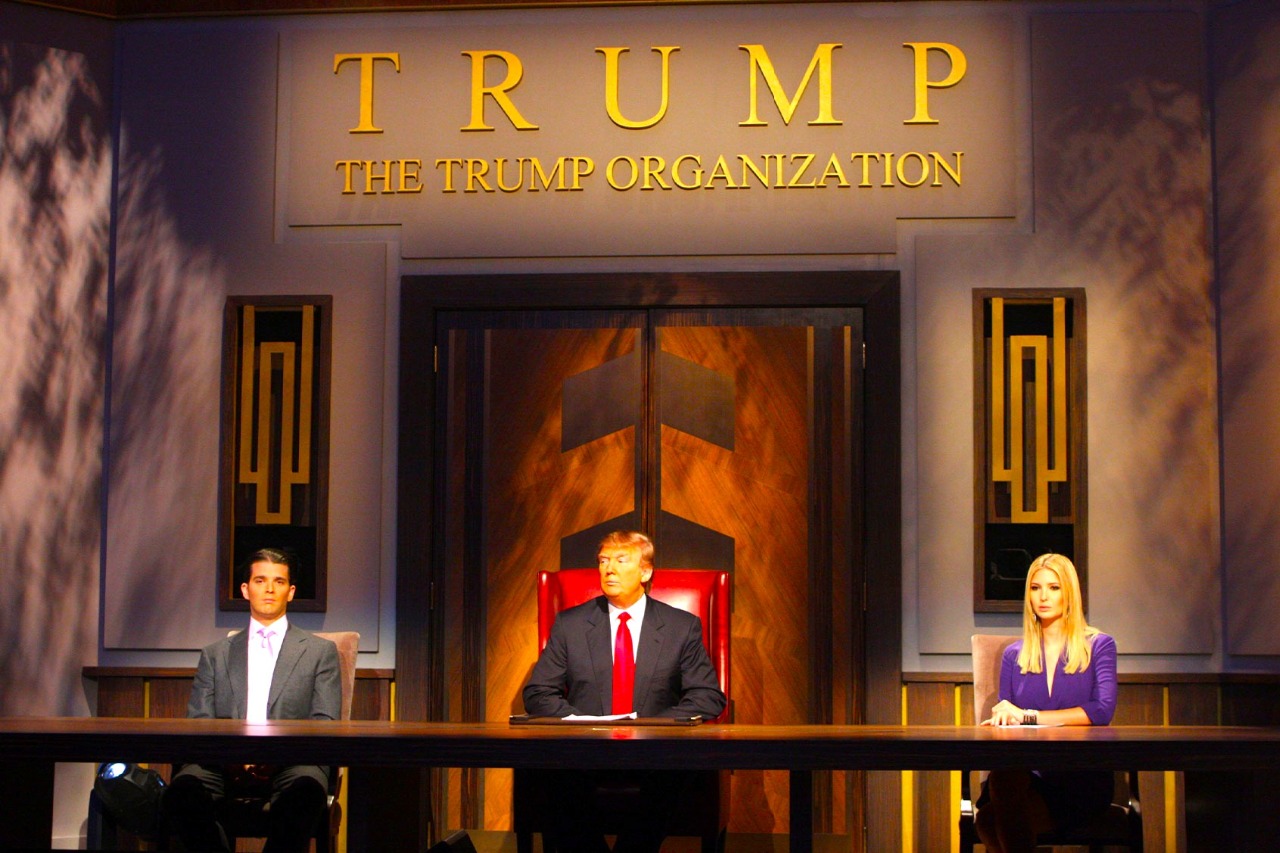
The task was now to create a solid, confidence-inspiring environment in which The Apprentice could unfold. The seedy surroundings in which Trump typically moved could certainly not suffice if he were to be portrayed as a successful, wealthy magnate. A space was acquired with Trum Tower and transformed to provide an imposing, somewhat intimidating, and formal setting for the final judgments to be handed down by an imaginary “absolute authority” – Donald J. Trump.
Network executives carried out the day-to-day handling of The Apprentice, and hired a space in Trump Tower to create a fake boardroom where Trump would coin his famous catchphrase: 'You're fired!' […] Our job was to make him look legitimate, to make him look like there was something behind it, even though we pretty much all knew that there wasn’t – but that was our job.
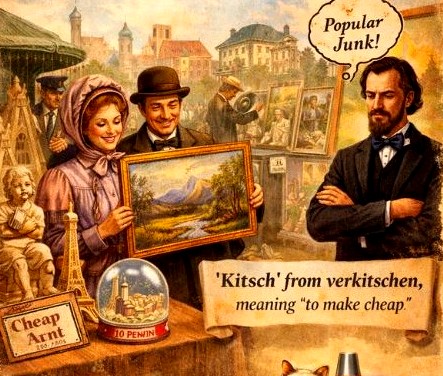
Perhaps this is here we find the origin of Trump’s taste for gold and marble. a realization that one can conceal one’s true self behind a façade made up of kitsch. This term refers to art, objects, or design that through their excessive sentimentality, or overt ostentation, are considered to appeal to the “general public.”
Originally a German word, it alluded to art created to cater to “popular” taste. Art produced solely for commercial interests. The term kitsch was coined by critics of the “art” they had encountered in the flea markets of Munich during the 1860s. It derives from the Bavarian expression kitschen, which referred to the practice of manufacturing new furniture by incorporating parts taken from older pieces. The term verkitschen implied the marketing of goods that were not what they purported to be, for instance, “art” that, in the view of these critics, failed to meet the criteria required to be considered as “genuine” art.
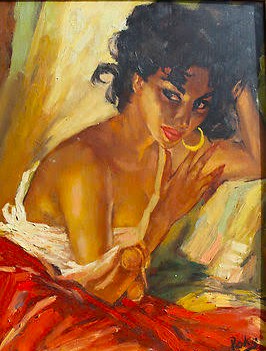
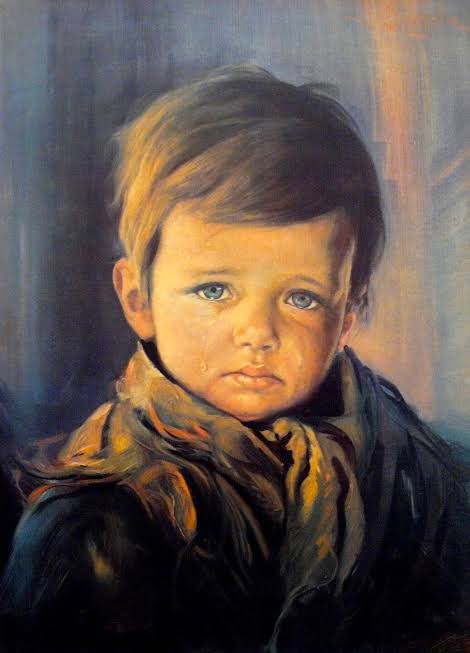
From this origin evolved the commercial kitsch that, thanks to inexpensive reproduction techniques, became accessible to each and everyone. Before long, the walls of millions of homes were adorned with the seductive gypsy women originally painted by the Hungarian-born, Norway-based artist Charles Rokas (Róka Károly), or weeping children by the Italian painter Giovanni Bragolin.
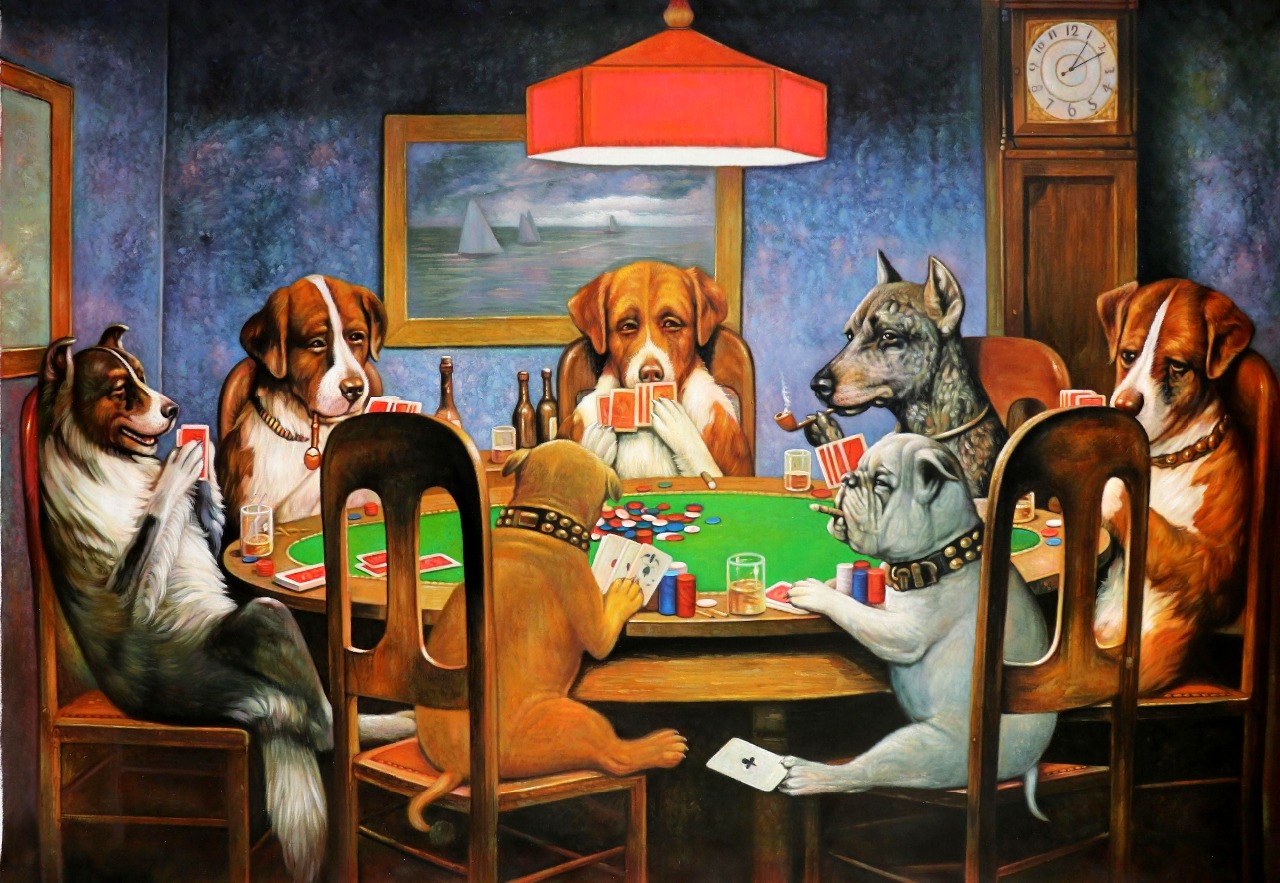
Along with the American Cassius Marcellus Coolidge’s card-playing dogs, or countless “hand-painted” Parisian cityscapes and weeping clowns.
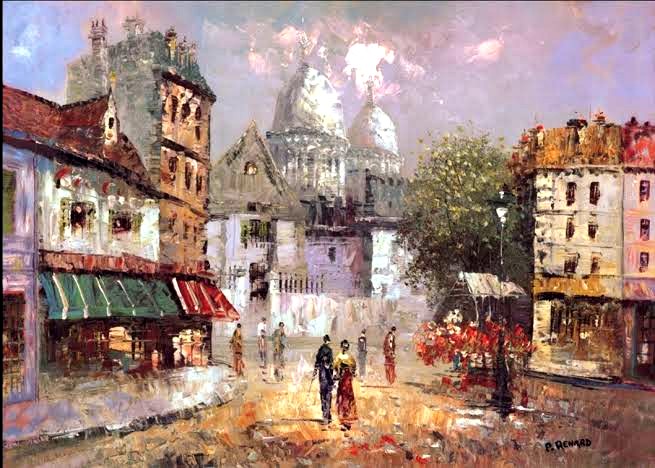
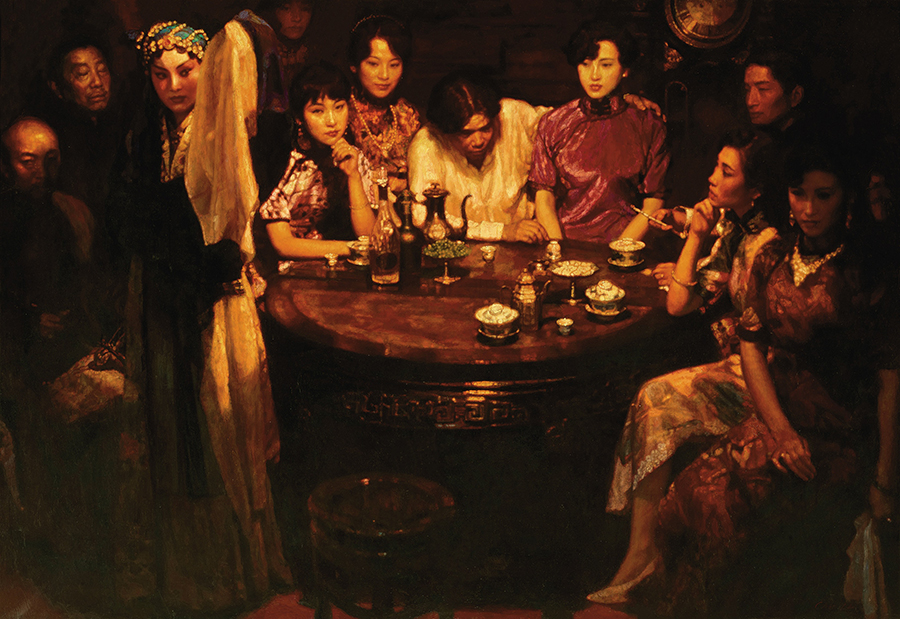
As with everything related to style and taste, perceptions of what constitutes kitsch vary widely and are, for the most part, highly personal. It is generally a matter of feeling. Realistic art is frequently labelled as kitsch; for instance, many connoisseurs consider the work of Shanghai-based artist Chen Yifei to be an example of "elevated kitsch, a classification that did not prevent his painting Warm Spring in the Jade Pavilion from fetching the equivalent of USD 22.7 million at a Chinese auction in 2017, making it the highest price so far paid for a work by a living Chinese artist.
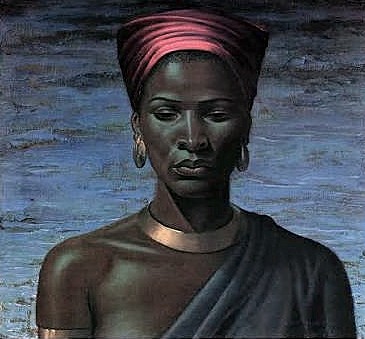
The Russian-South African artist Vladimir Tretchikoff (1913–2006) was known as the King of Kitsch and reproductions of his art were distributed worldwide to millions of appreciating customers. The original paintings also fetched substantial sums, combined with the sales of his reproductions. This made Tretchikoff, ranked just behind Picasso, as one of the wealthiest artists in the world.
There is quite a lot disagreement as to whether Tretchikoff’s work qualifies as “art”. At times, it has been favourably compared to highly respected works from the German and Italian Neue Sachlichkeit, New Objectivity movement of the 1920s and 1930s.
Admittedly, most art – whether "good" or "bad" – might be said to be created to provide the artist with an income. Nevertheless, kitsch has but one purpose: to sell well. Consequently, kitsch lacks what the philosopher Walter Benjamin termed as aura, an elusive concept that might be described as the sense of genuine creative power and originality, which surround an original work of art in these times of mechanized, commercial production.
In any case, kitsch is difficult to define, yet it cannot be denied that it surrounds us everywhere, for instance, in the form of tasteless souvenirs.
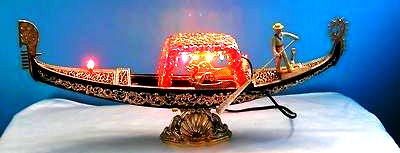
or religious knick-knacks.
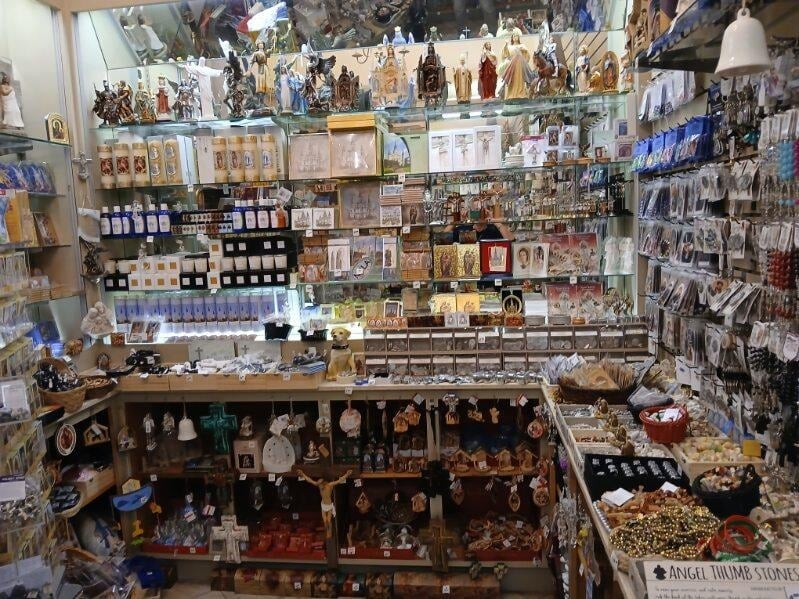
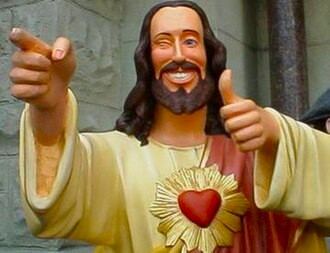
Not to mention all the mass-produced art that adorns our walls. It is obvious that such art is frequently executed in an amateurish fashion. However, this does not mean that kitsch is synonymous with “naïve art”, which often is endowed with what Walter Benjamin called an aura. Consider, for instance, the works of the naïve master Henri Rousseau.
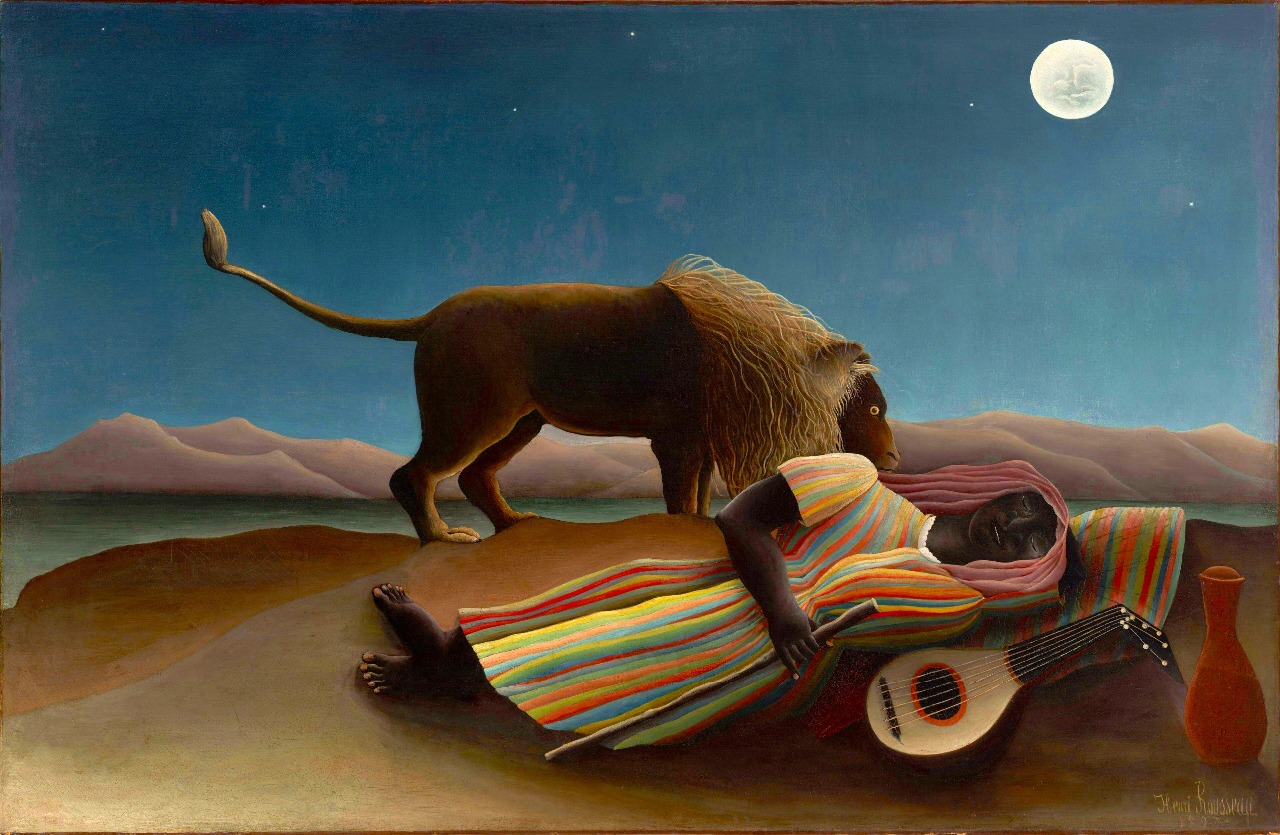
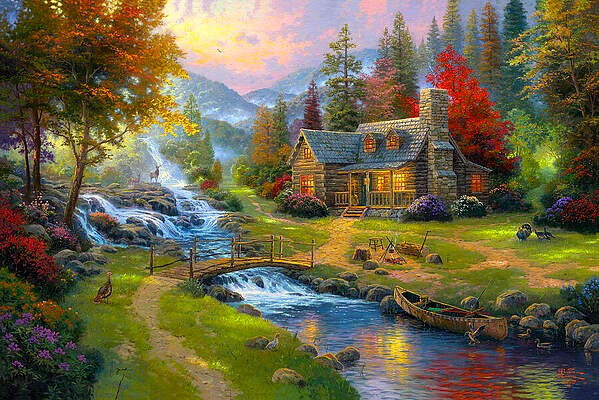
and compare them with the works of United States’ undisputed producer of kitsch, Thomas Kinkade, whose work can be found in millions of homes, especially throughout North and South America.
Condemnation of kitsch has often been linked to disdain of an elitist "snob culture" which is assumed to despise everything that appeal to the general public. For instance, the American art critic Clement Greenberg waged a constant war against kitsch and what he described as the tastes of the common man being debased by commercialism. Greenberg believed that the era of representational art had come to an end, and that artists who continued to express themselves through realistic works were merely epigones, plagiarists of an art form which time had irrevocably been gone. Realism, he argued, now belongs to the realm of advertising and propaganda, whereas true, modern art is synonymous with abstraction; an expression of emotions and aesthetic pleasure that, through its combination of colour and form, has transcended the now-obsolete sphere of imitation.
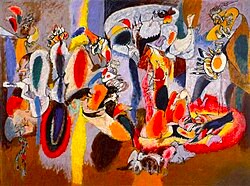
Obviously, Greenberg faced opposition. Criticism came not only from defenders of “popular culture,” but also from highly sophisticated critics and writers such as Susan Sontag, who in her 1964 essay Notes on Camp introduced the concept of “camp”, almost as a kind of “revenge of the intellect upon art.” According to her, we are free to decide for ourselves what constitutes art. If kitsch appeals to us, it is no longer kitsch. It is the observer who bestows an aura upon art.
High Camp always has an underlying seriousness. You can't camp about something you don't take seriously. You're not making fun of it, you're making fun out of it. You're expressing what’s basically serious to you in terms of fun and artifice and elegance. Baroque art is basically camp about religion. The ballet is camp about love.
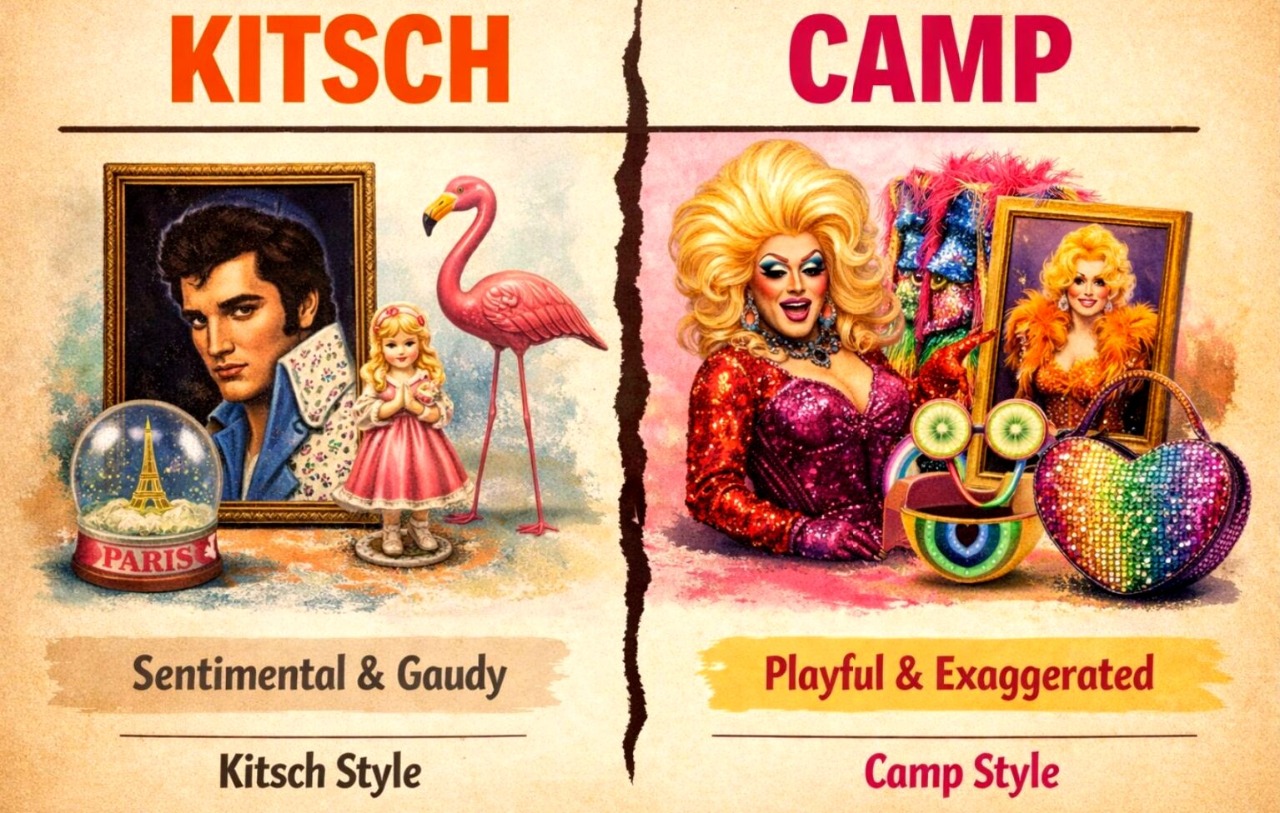
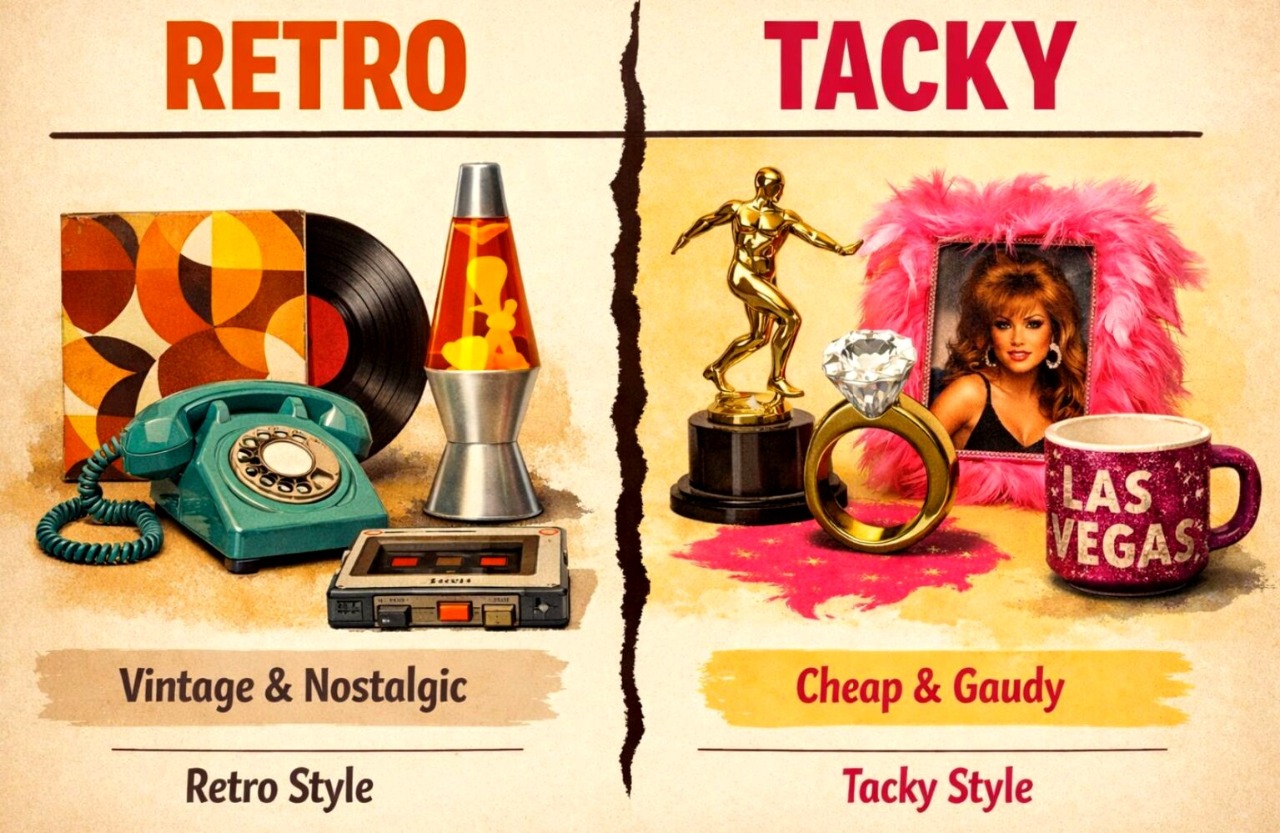
Sontag allows her own taste to reflect the concept of "camp." She presents lists of what she considers to be camp—for instance, Tchaikovsky’s Swan Lake, Tiffany lamps, Flash Gordon, women’s fashion from the 1920s, and much more. According to her, a great deal of Mozart’s music, as well as the operas of Bellini and Richard Strauss, qualify as camp, though Wagner’s music does not. Evidently, Sontag herself appreciates everything she labels as camp.
What Sontag emphasized was the freedom of art. A composer, sculptor, writer, or painter could, provided they had the desire and the ability, freely draw upon the work of predecessors, whether good or bad, to create something new and often entertaining. The artistic movements of the twentieth century bear witness to this; kitsch has left its mark on several masters associated with Dada, Surrealism, Pop Art, and Hyperrealism.
One example is the ever-changing Francis Picabia, a founder of Dadaism, who moved freely and audaciously from one style to another: "If you grow tired, then change your style just as you would change your shirt."
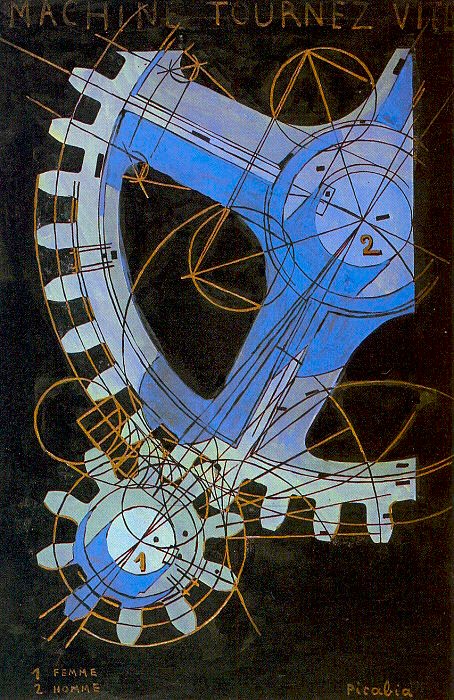
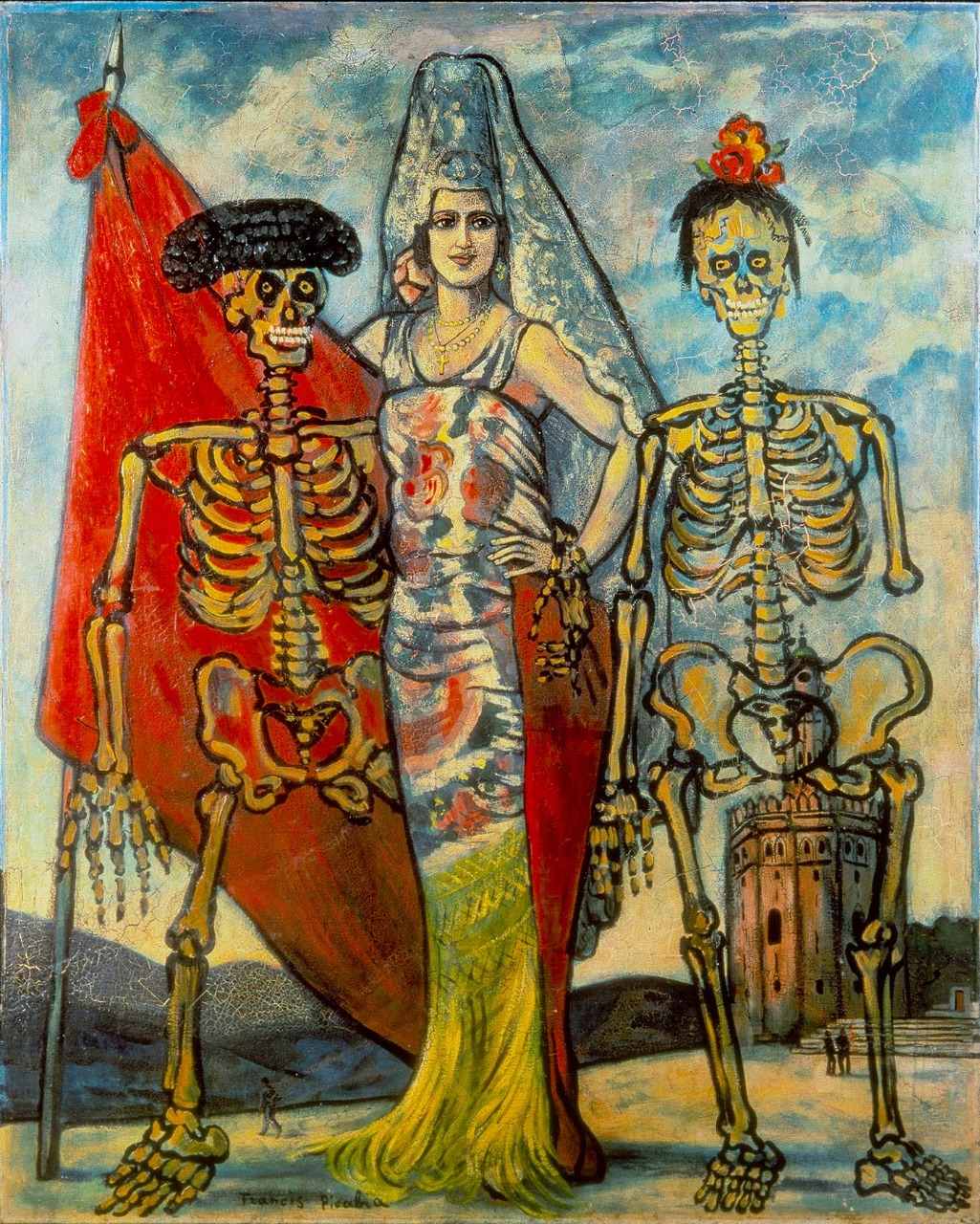
In the late 1930s, Picabia suddenly began painting a series of works based on photographs and newspaper clippings, a technique that prompted several other artists to follow in his footsteps. Picabia generally chose nondescript, rather kitschy subjects, and the results are reminiscent of the art of Bob Dylan, who in his paintings frequently creates detailed imitations of other people’s original works.
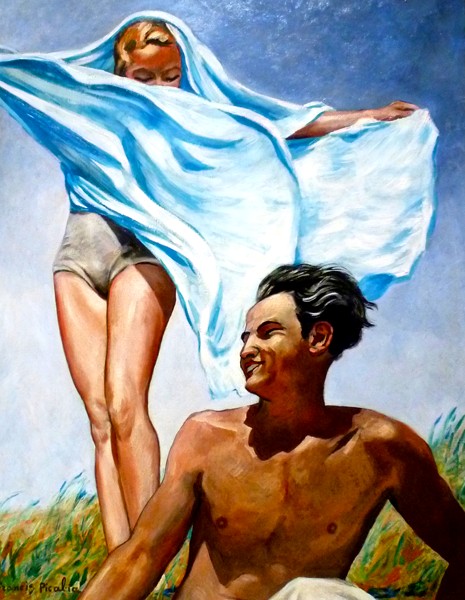
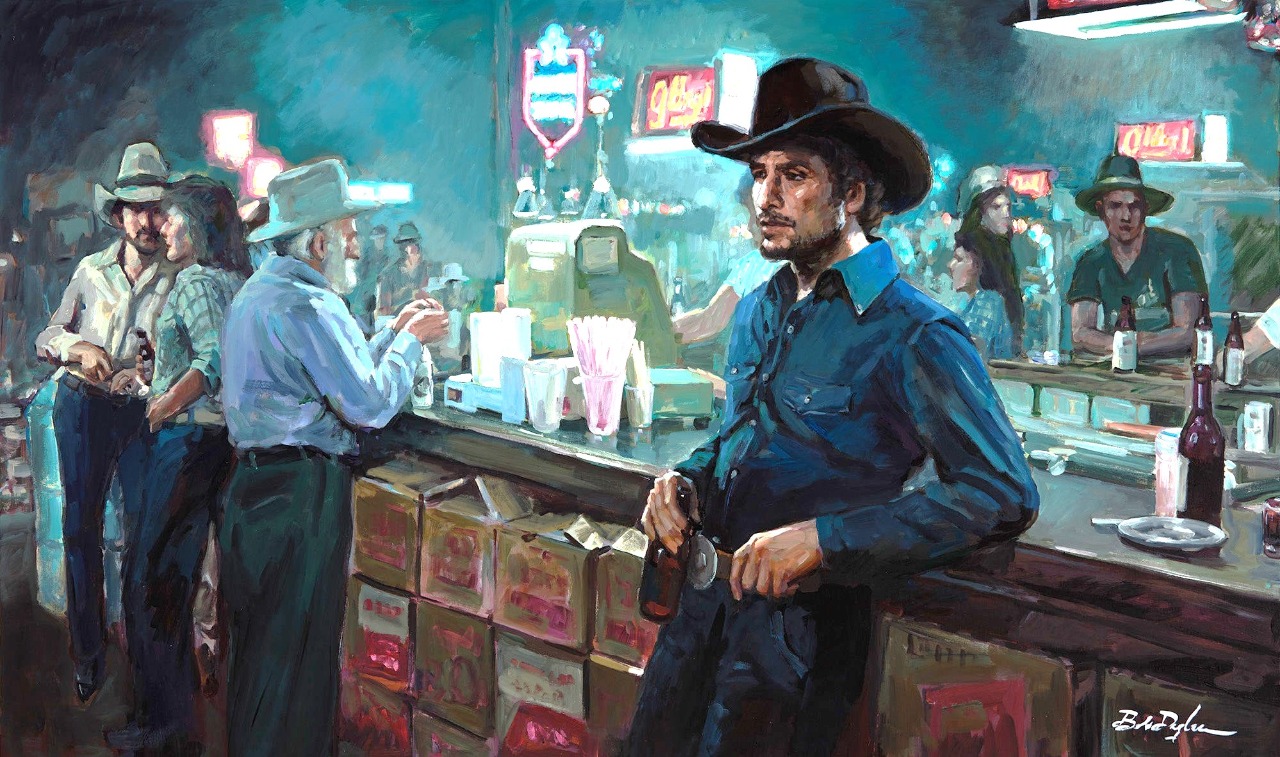
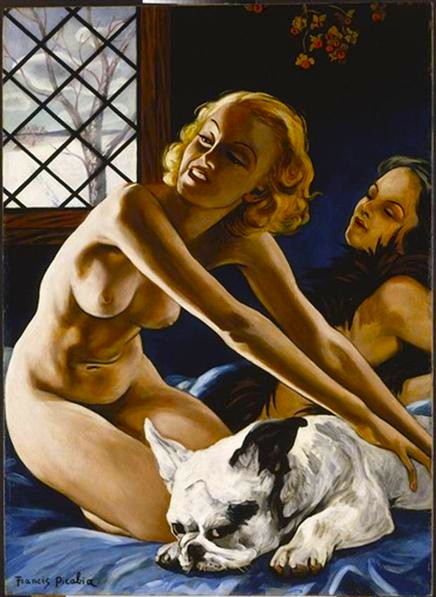
During the war, Picabia shifted entirely to producing kitsch. He moved to the south of France, where he created a series of paintings featuring nude women, modelled after “glamour photos” he had found in men’s magazines such as Paris Sex-Appeal. As if to mock traditional, academic nude painting, Picabia executed these works in a garish, rather clumsy style. He sold several of these pieces to an Algerian merchant, who then resold them, a turn of events that resulted in Picabia’s nude women during The Occupation ended up decorating a number of brothels across North Africa.
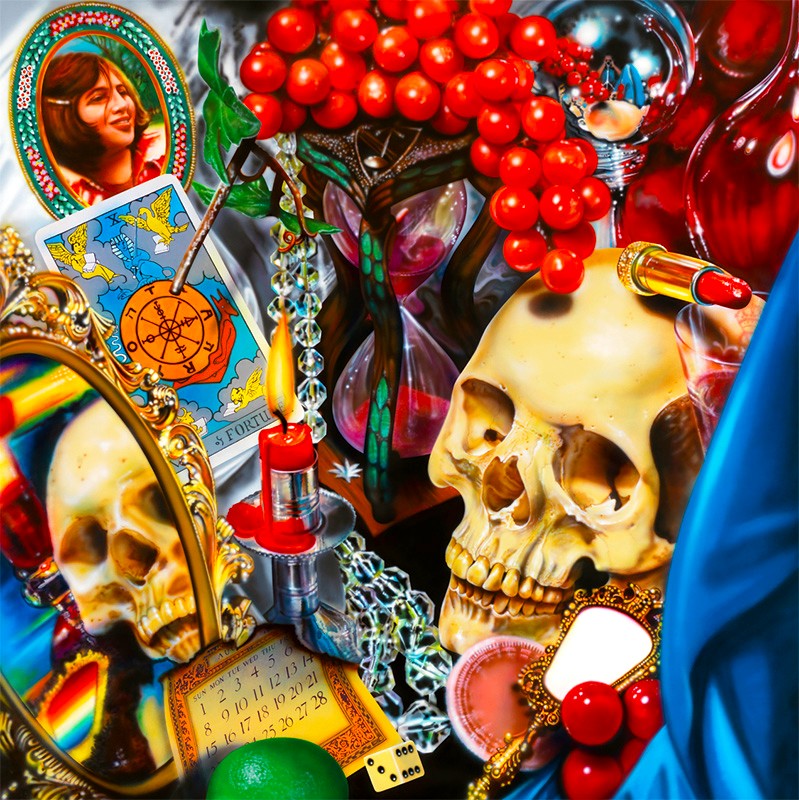
Later, hyperrealists such as Audrey Flack have created modern vanitas motifs in highly detailed oil paintings while incorporating meticulous depictions of New Age - and religious kitsch.
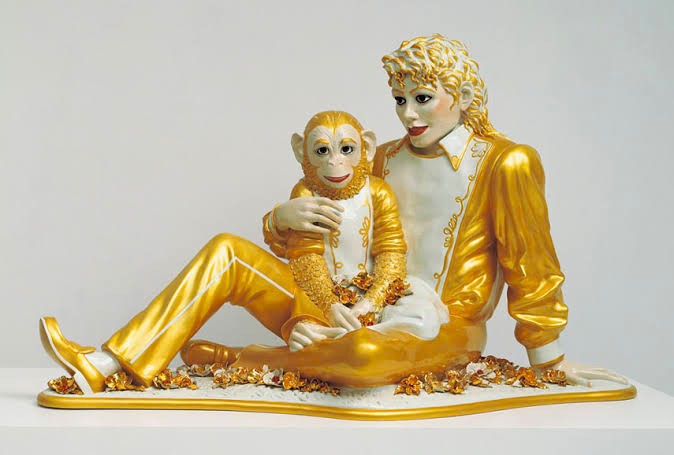
Wile, Jeff Koons has rendered kitschy objects in various materials, such as steel, porcelain, marble, and flowers, and in different sizes.
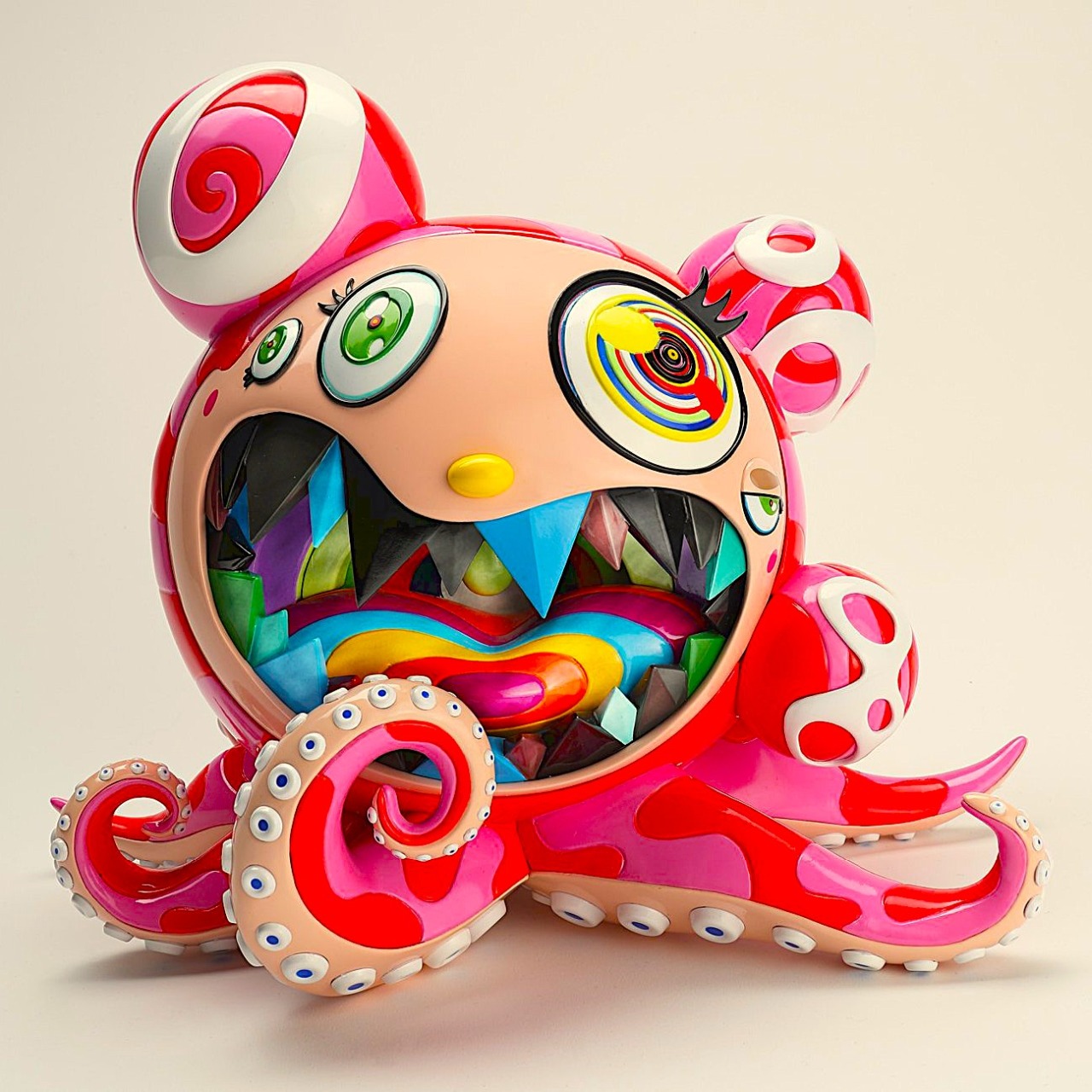
And in Japan, Takashi Murakami became a millionaire by reworking motifs from Japanese mangas and commercial kitsch.
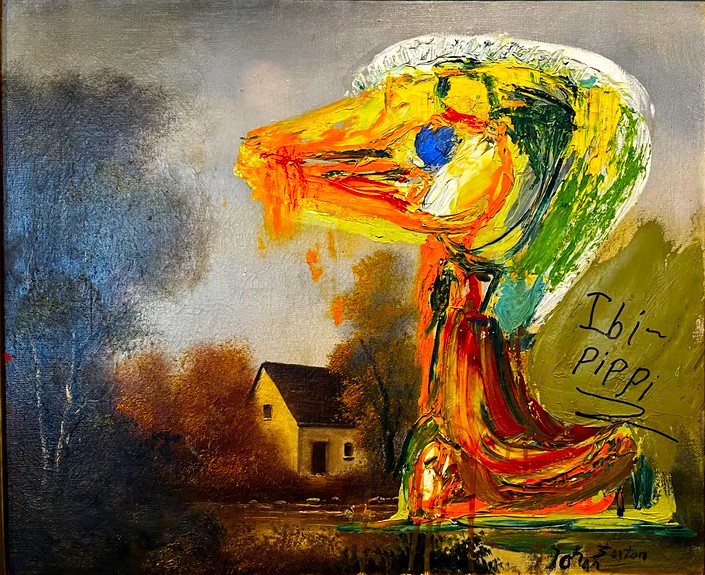
Other artists have taken a more ironic approach to kitsch, such as the anarchistic Dane Asger Jorn, who amused himself with "vandalist art" by painting over mass-produced, folksy paintings (which he had acquired from various sources) with grotesque, thickly applied "anti-structures," as seen here in his Ibi Pippi.
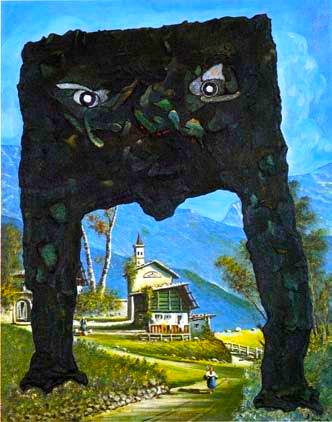
In the same year, 1955, as Ibi Pippi came into being, the Italian artist Enrico Baj created his impressive Swiss Invasion.
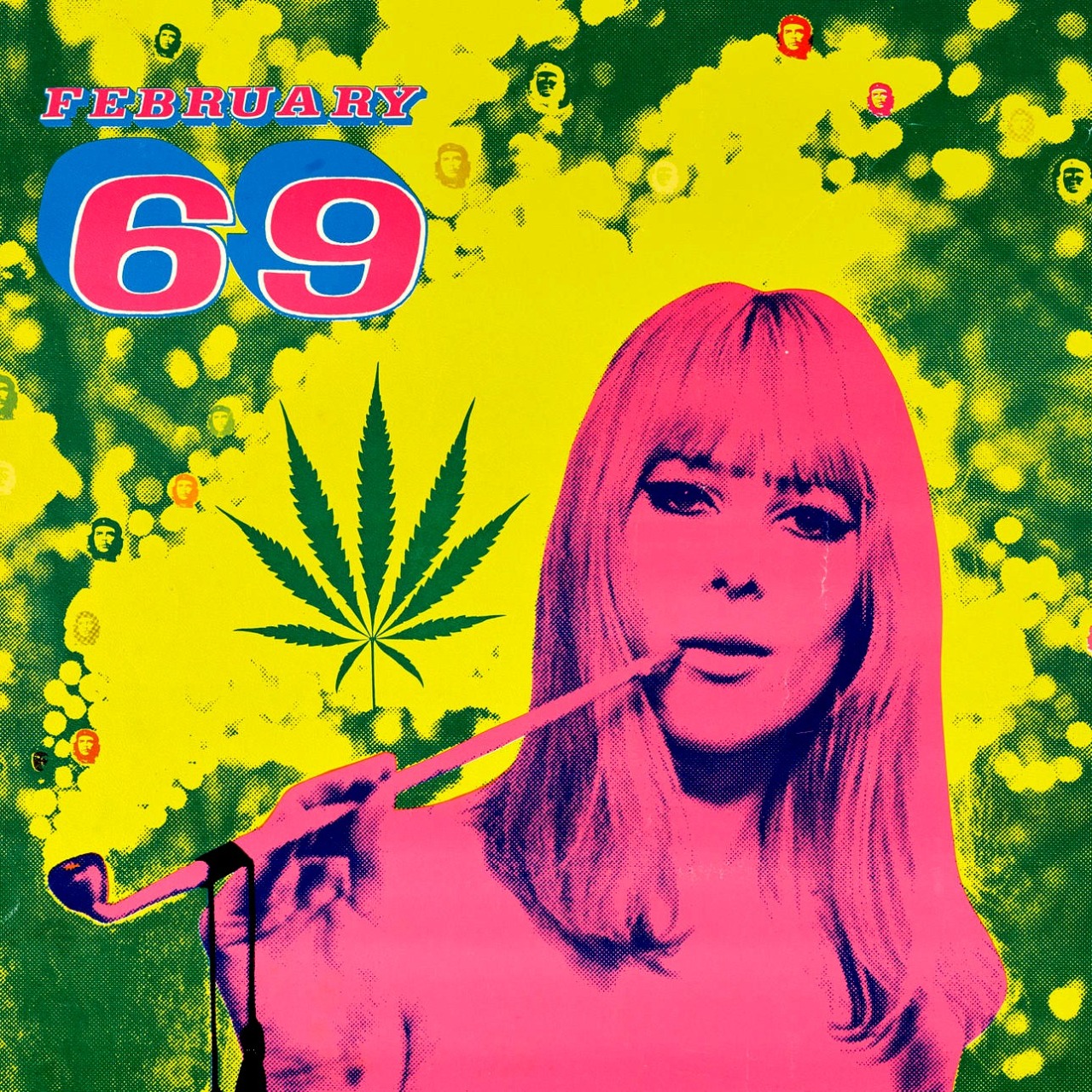
Even more anarchic was Sture Johannesson, a native of Vinslöv, a village close to my town of birth, whose psychedelic poster featuring a naked woman smoking a hash pipe, caused the resignation of the director of Lunds Konsthall in southern Sweden, the reason was that he had accepted and distributed the poster.
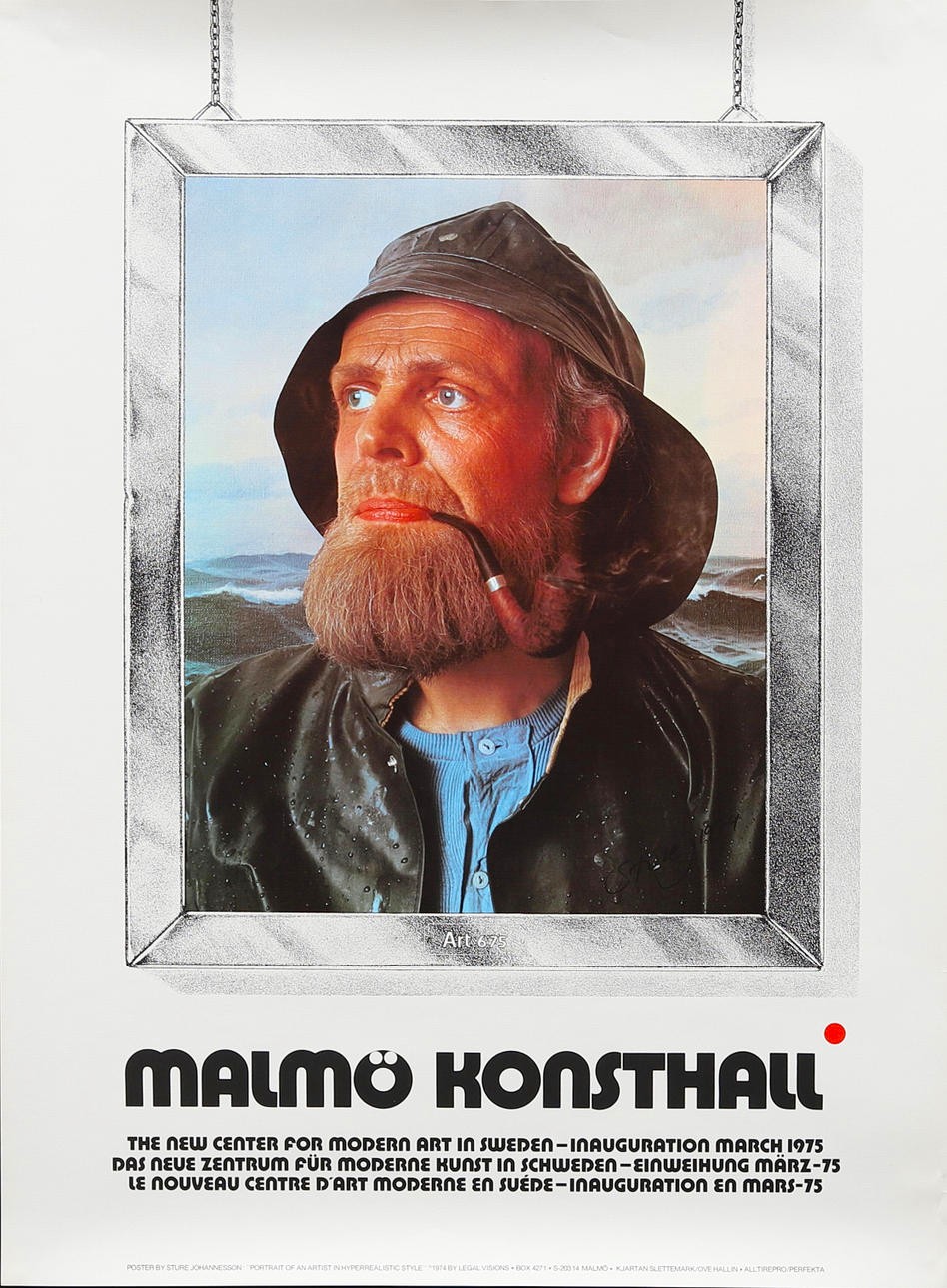
Johannesson continued along the same path, experimenting with various artistic techniques; among other things, he became a pioneer in the field of digital art. He frequently employed kitsch as a mode of artistic expression, for instance, in a poster in which he depicted Kjartan Slettermark, a fellow anarchist even more hostile toward the establishment, as "The Old Fisherman" Der alte Seebär.
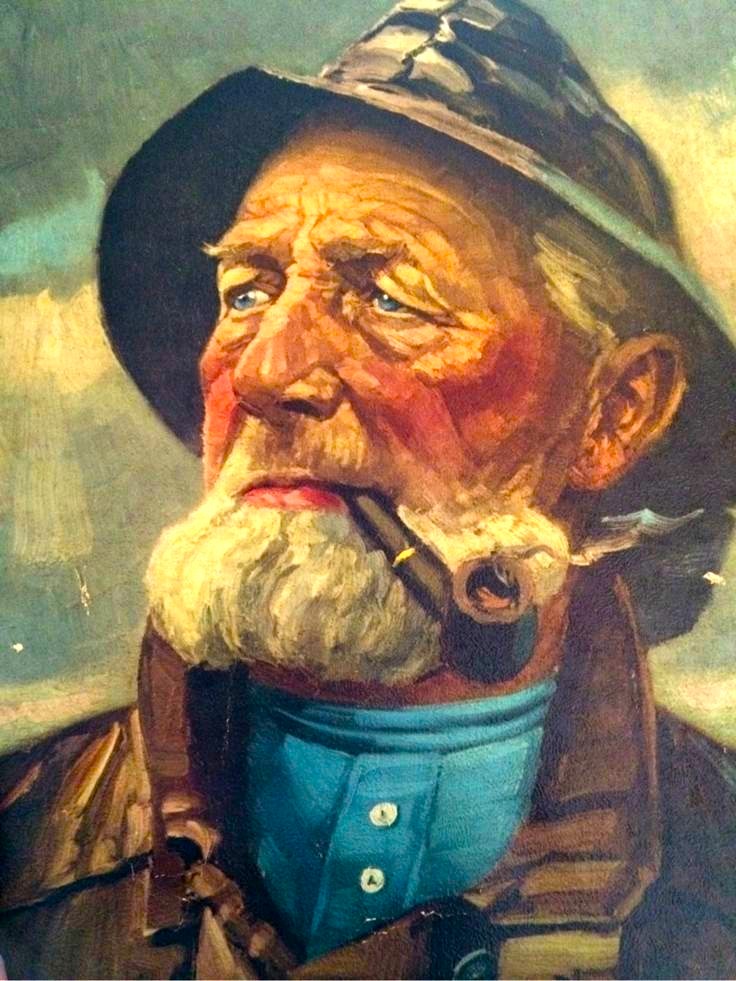
The poster was a parody of an immensely popular kitsch motif by the German artist Harry Haerendel. After the publishing house Åhlén & Holm mass-produced reproductions of Der alte Seebär in 1955, the image ended up on the walls of countless Scandinavians.
But let us now leave these more or less genuine artists aside and turn our attention to Trump’s favourites. The American president’s taste can hardly be defined as camp in the sense intended by Susan Sontag. To me, it undeniably comes across as kitsch, in the worst sense of the word. It is art created to flatter and satisfy the person who commissioned it, while also, in his view, impressing the viewer. For instance, the portraits with which Trump surrounds himself strike me as nothing more than pathetic, simple-minded, and insecure.
Take, for example, Ralph Wolfe Cowan’s bombastically sycophantic The Visionary, which hangs in a place of honour at Trump’s resort Mar-a-Lago. A depiction of a youthful Trump that bears little resemblance to the man himself.
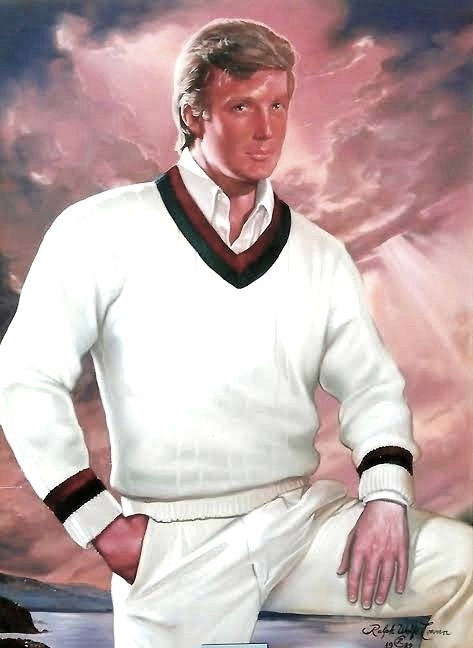
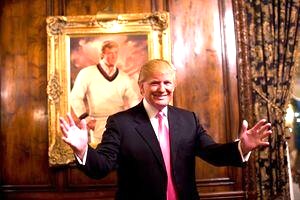
Cowan’s art, which, in my view, comes through as unusually banal, ingratiating, and vacuous, seems to have exerted an immense appeal upon the world’s powerful and wealthy potentates. He produced numerous portraits of the various members of the Princely Family of Monaco and depicted presidents Reagan, Carter, Johnson, Kennedy, and Gorbachev (though the latter was, strictly speaking, a premier minister), as well as Arab kings and sultans, including the popular Sheikh Zayed, founder and first leader of the United Arab Emirates, complete with the favoured accessories of Arab princes – a thoroughbred stallion and hunting falcons.
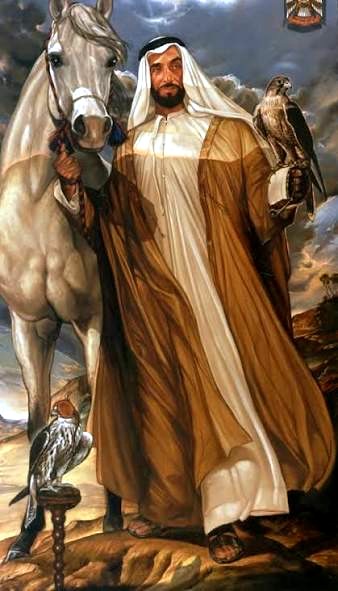
This is perhaps the primary hallmark of Cowan’s art – props and superficiality. The powerful, high-paying potentates were likely not seeking a profound, soul-searching portrait. The external trappings were what mattered most, tailcoats adorned with sashes and medals, macho men heading off to tennis- and golf courses, or a fox hunt, while women are depicted dressed in flowing silk gowns. All of them members of the propertied classes – the rich and famous.
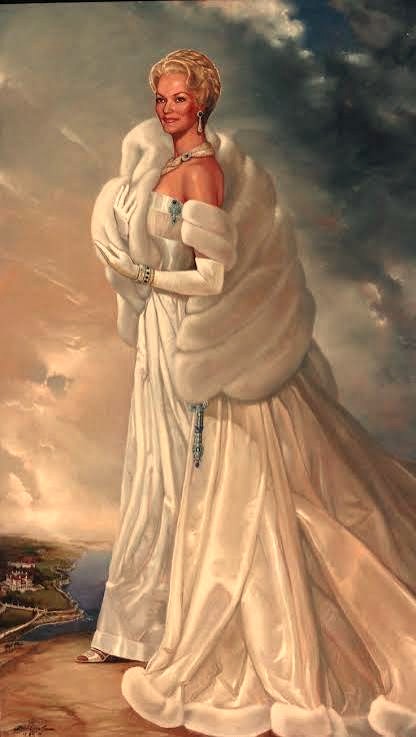
The rest of Cowan’s body of work ruthlessly reveals his implausibly saccharine passion for embarrassingly tasteless kitsch, leaving me to wonder how this wretched artist, who would have been far better suited to paint birthday greeting cards for Hallmarks, managed to find favor with so many powerful leaders and millionaires. They likely tipped one another off by stating that this skilled master of kitsch was capable of fulfilling their wishes for majestic splendor left behind as a legacy for coming generations. The downside is that the future artistic value of these works will almost certainly be nil.
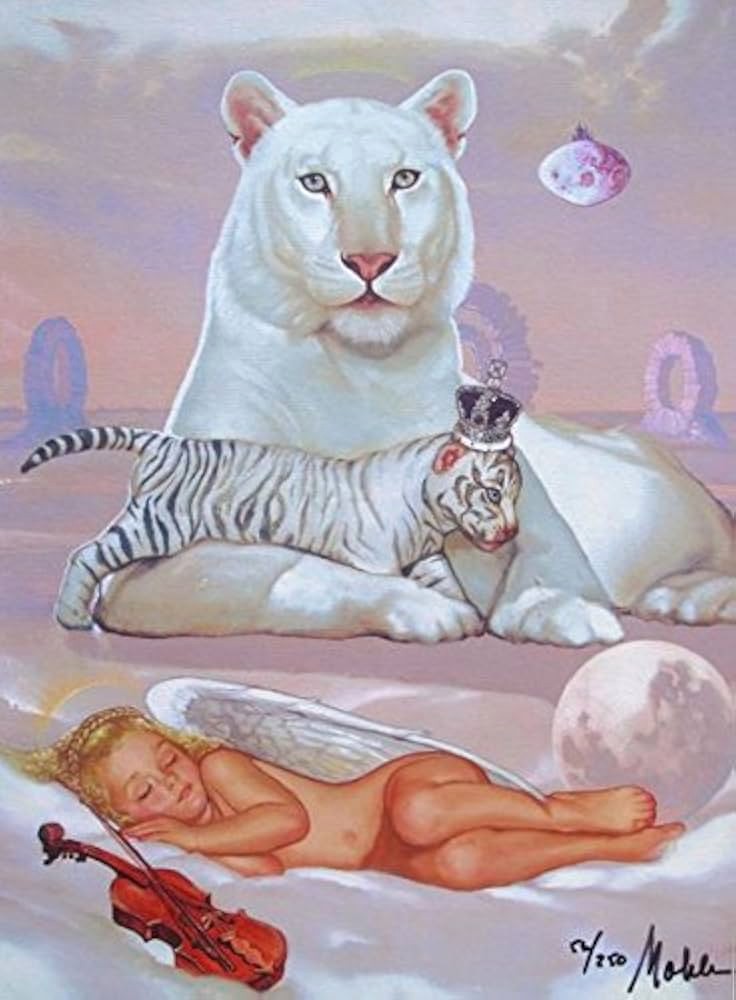
Cowan’s poster-like portraits of famous entertainers, such as Marilyn Monroe, Tony Curtis, Nancy Sinatra, Steve Wynn, and, not least, Elvis Presley, are equally dreadful. The portrait of the latter, which adorns a central wall at Graceland, depicts the singer as a divine figure, thereby bringing to mind other artists who have painted portraits of Trump.
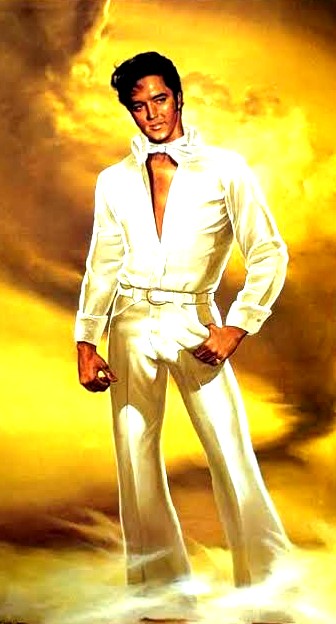
The portrait that Trump evidently intends to become the official depiction of him once he has left the presidency was painted by John Howard Sanden.
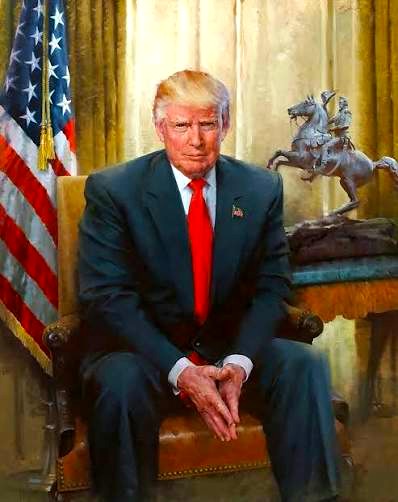
Sanden had previously created the presidential portrait of George Bush and had for several years, served as art director for Billy Graham’s organization, The Billy Graham Evangelistic Association (BGEA). Graham was a Southern Baptist who garnered immense attention through his massive revival meetings. He later became religious advisor to Presidents Eisenhower, Johnson, Nixon, and Clinton, as well as both Bushes. Graham’s organization, the BGEA, published a wealth of religious literature, most of it written by Graham himself, and also distributed other religious materials. Furthermore, the BGEA produced a series of Christian films, in several of which Billy Graham appeared as himself.
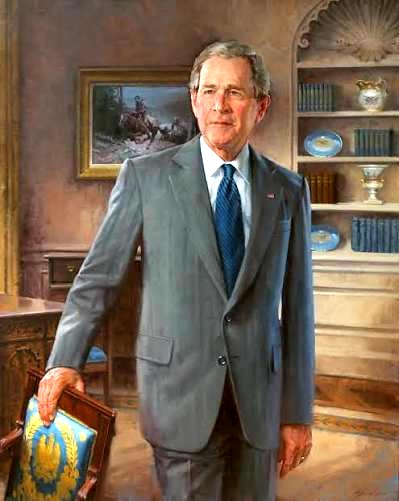
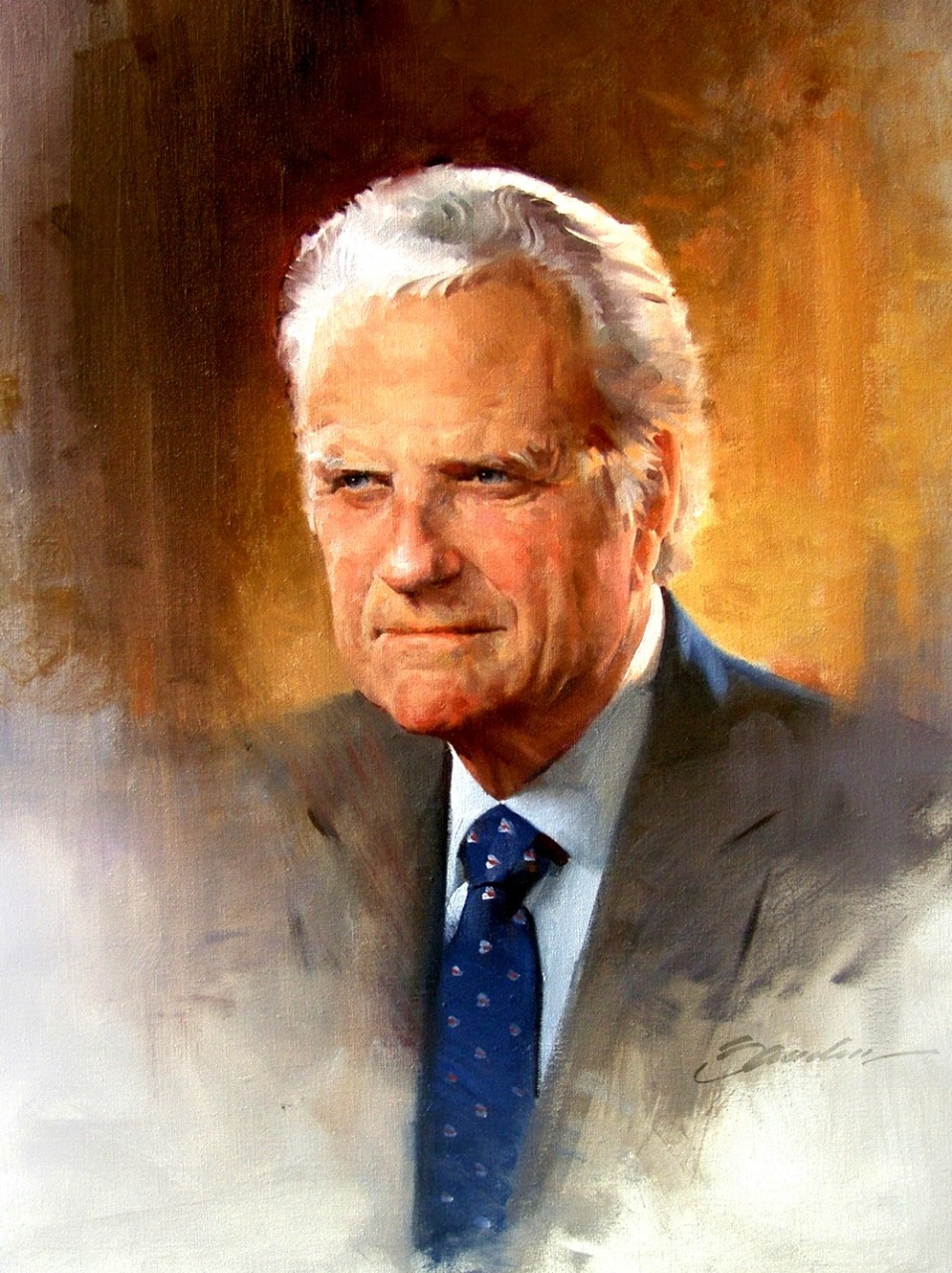
John Howard Sanden’s art appeared to follow the same path as those unoriginal, yet competent illustrations once found in Reader’s Digest or on the covers of early issues of Time Magazine, before they switched to using photographs.
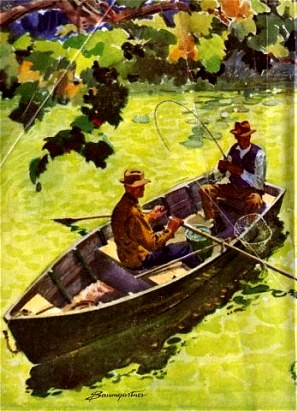
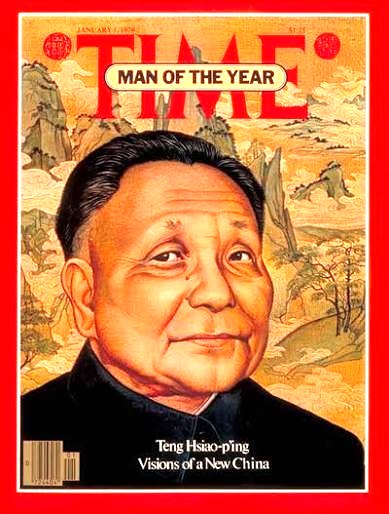
There is nothing wrong with that, though Sanden’s portraits offer no profound character studies; equally bland are his many depictions of Jesus Christ, all executed in the same conventional, pious style, featuring a blond Jesus surrounded by a halo of light.
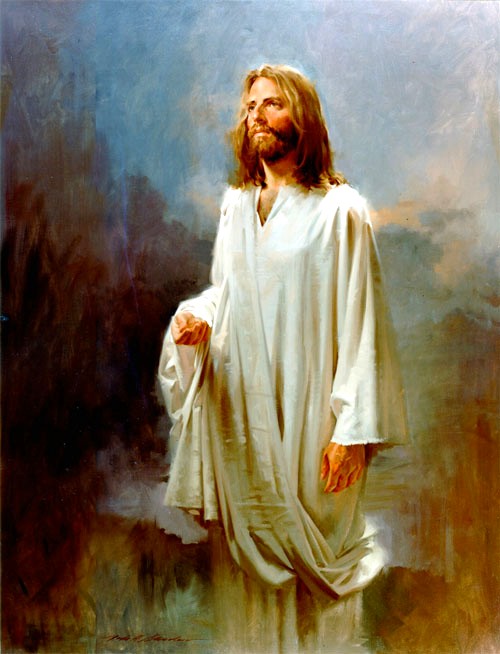
Pious depictions that make no demands, or efforts and impose no obligations concerning compassion and sacrifices. Celebrations of a childlike faith in which Jesus, the angels, and the Madonna appear as living, almost contemporary entities, have long been a key ingredient in Christian kitsch. A tradition ranging from guardian angels by the Austrian artist Hans Zatzka and dating from the late 19th century
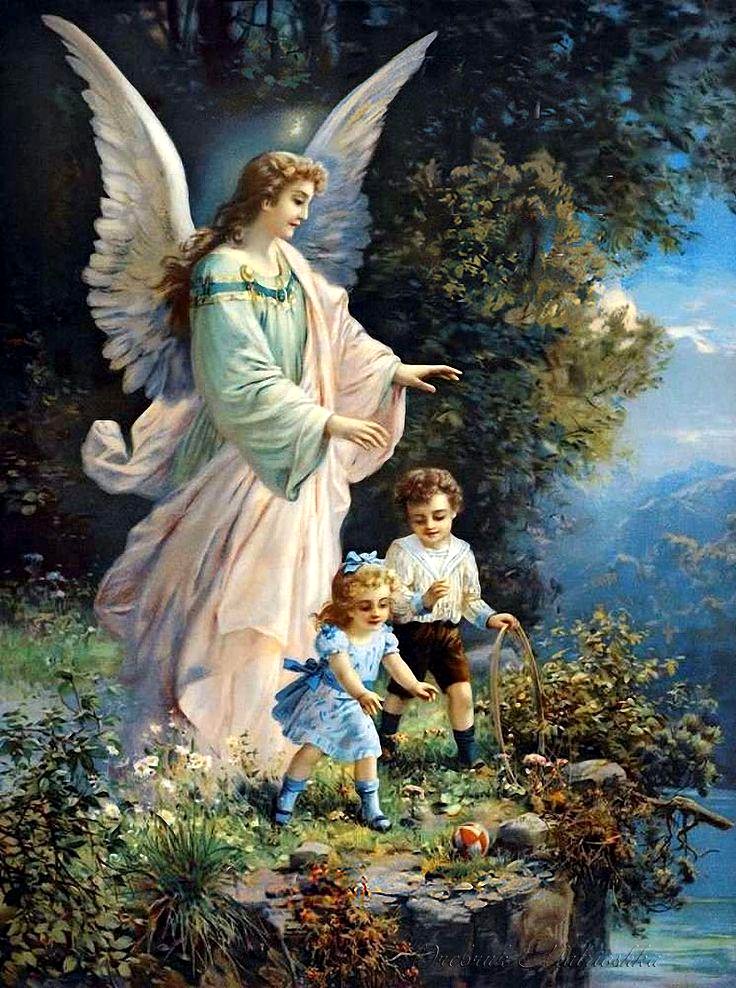
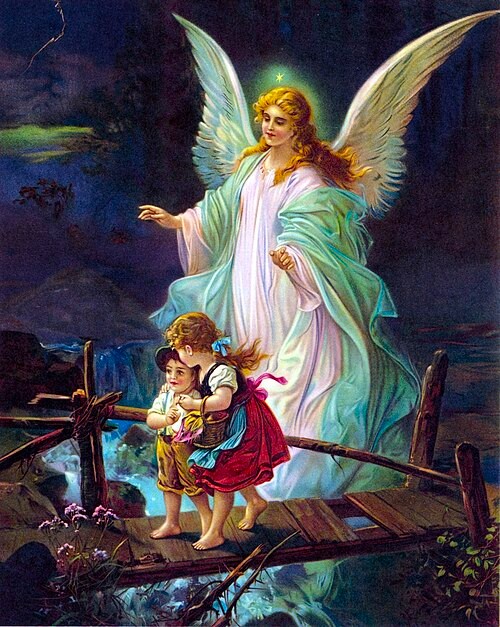
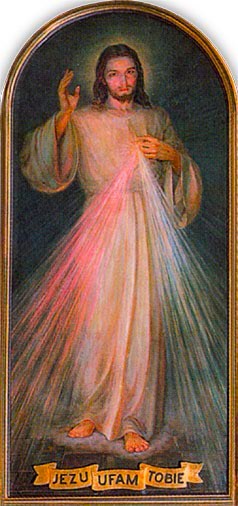
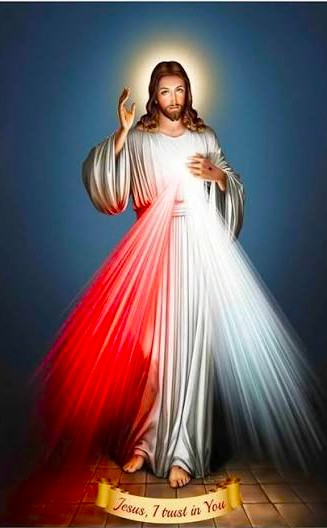
and leading up to Eugeniusz Marcin Kazimirowski’s Divine Mercy, a somewhat “improved” version of the original is now adorning the interiors of numerous Catholic churches worldwide. The image’s immense popularity stems from the visions of, and conversations with Jesus experienced by the Polish nun Maria Kowalska (1905–1938). She recorded these in a diary, which was published after her death as The Diary of Saint Maria Faustina Kowalska: Divine Mercy in My Soul. This book was highly valued by Karol Wojtyła, who later became Pope John Paul II and then subsequently decreed that the second Sunday of Easter should be celebrated as Divine Mercy Sunday. It is said that the image of Divine Mercy was painted by Kazimirowski under the direct guidance of Maria Kowalska.
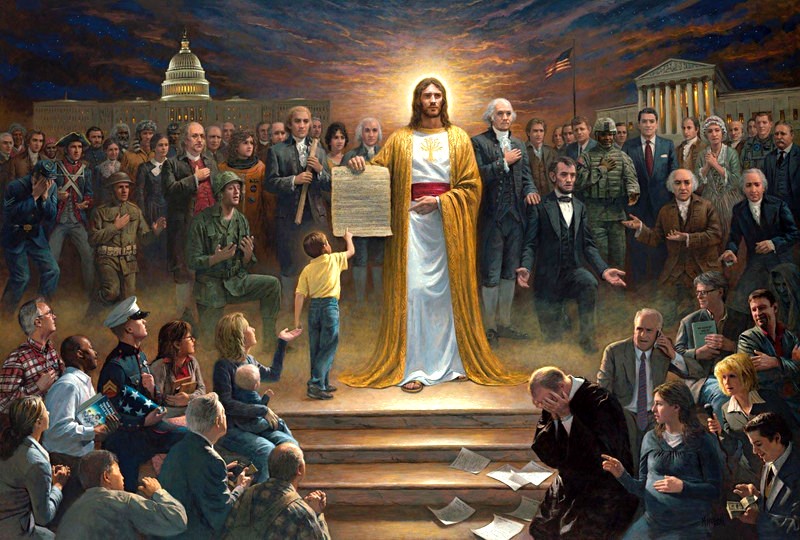
It is remarkable that the artists who have taken on the role of conveying Trump’s message appear not to be merely kitschy, most of them are also born-again Christians who feel no shame in portraying this convicted, inveterate liar and unrepentant libertine as a divine Saviour.
Particularly prominent among these Trump-worshippers is the Mormon Jon Austin McNaughton, whose sombre, rather stiff tributes to Donald Trump are immensely popular among his MAGA followers. For instance, in one work where McNoaugton depicts American presidents and patriotic icons bestowing blessings upon Trump, who sits by the White House desk with the Constitution before him, flanked by what might be the keys of St. Peter (or, maybe more accurately, the keys of The Aaronic Priesthood, a foundational Mormon concept) and the Bible. Among the figures offering their blessings upon the sitting President one can spot Reagan, Washington, Eisenhower, Kennedy, Lincoln, and Robert E. Lee. To ensure a greater degree of political correctness Frederick Douglass, Harriet Tubman, and Martin Luther King also appear in the scene.
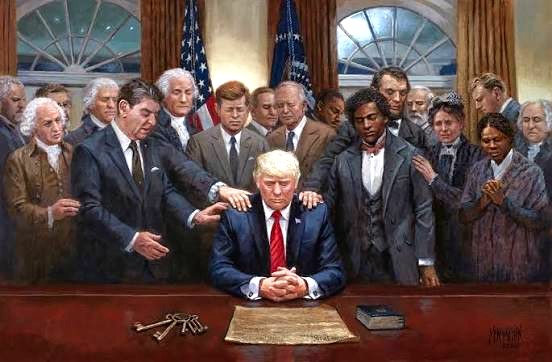
The whole thing is not only poorly executed but also comes across as clumsy and bombastic. As a devoted member of The Church of Jesus Christ of Latter-day Saints – which believes that the resurrected Jesus appeared to the Americans, more exactly the pre-Columbian Nephites and thus established Christianity on American soil - it is quite possible that McNaughton hopes the Tea Party Movement and Donald Trump will ultimately establish the new wonderous era and return of Jesus Christ as foretold by the angel Moroni.
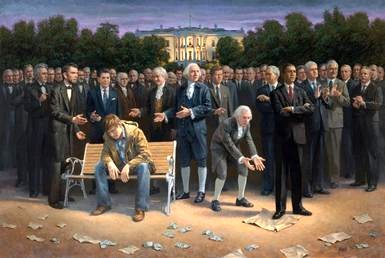
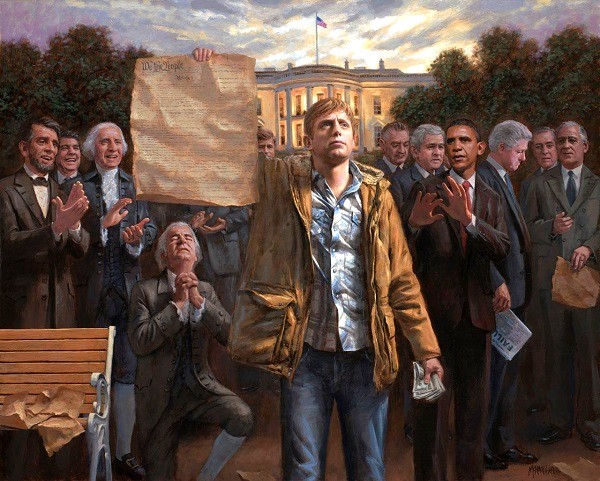
McNaughton’s tributes to Trump take on a particularly grotesque form in his series of paintings centred on "The Forgotten Man", a figure we first encounter sitting dejectedly on a park bench, while President Obama, to the dismay of the Founding Fathers, tramples upon the American Constitution.
However, Trump offers comfort to the dejected man.
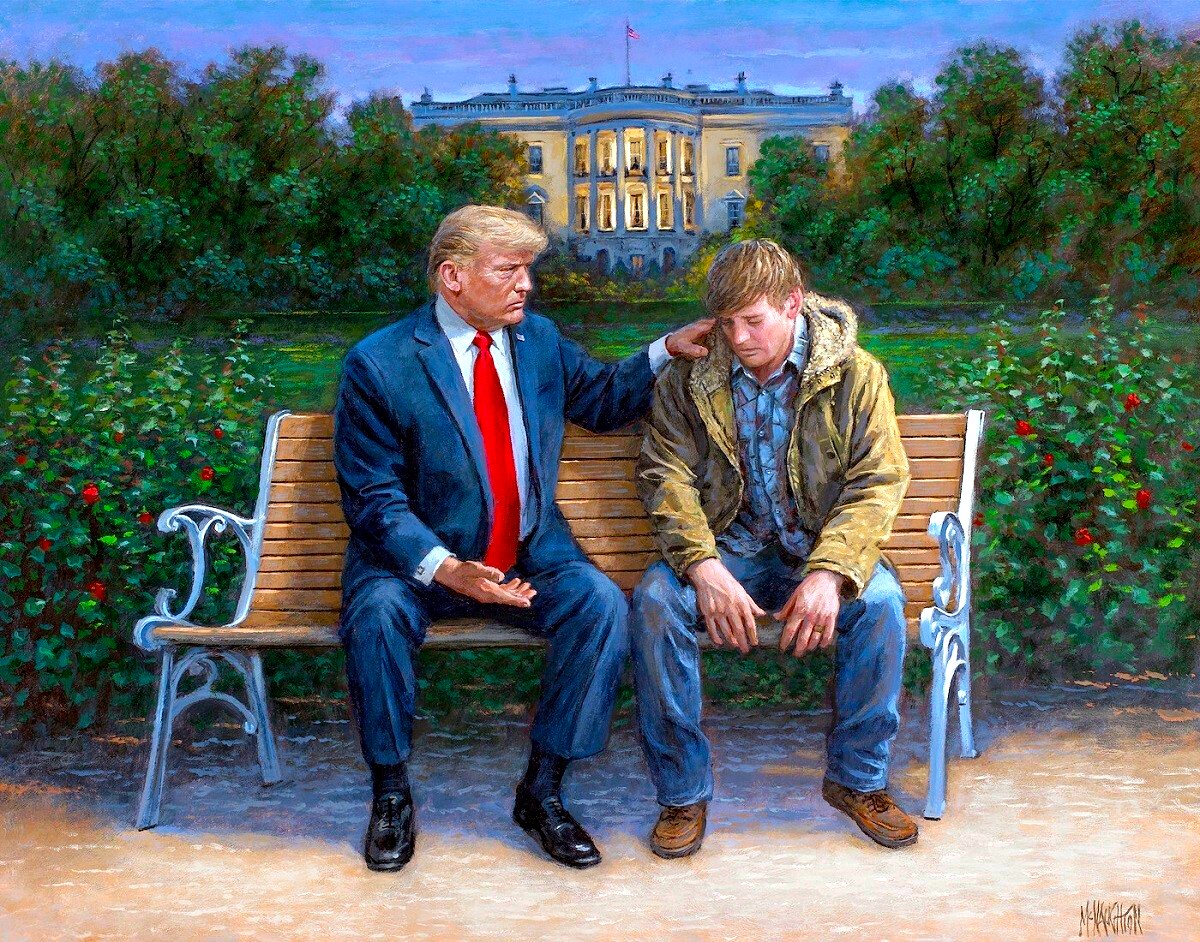
and causes him to proudly stand up proudly and with the Constitution in his hand confront the evil and scheming representatives of liberals and democrats, who retreat in shame while the Founding Fathers applaud in relief and gratitude.
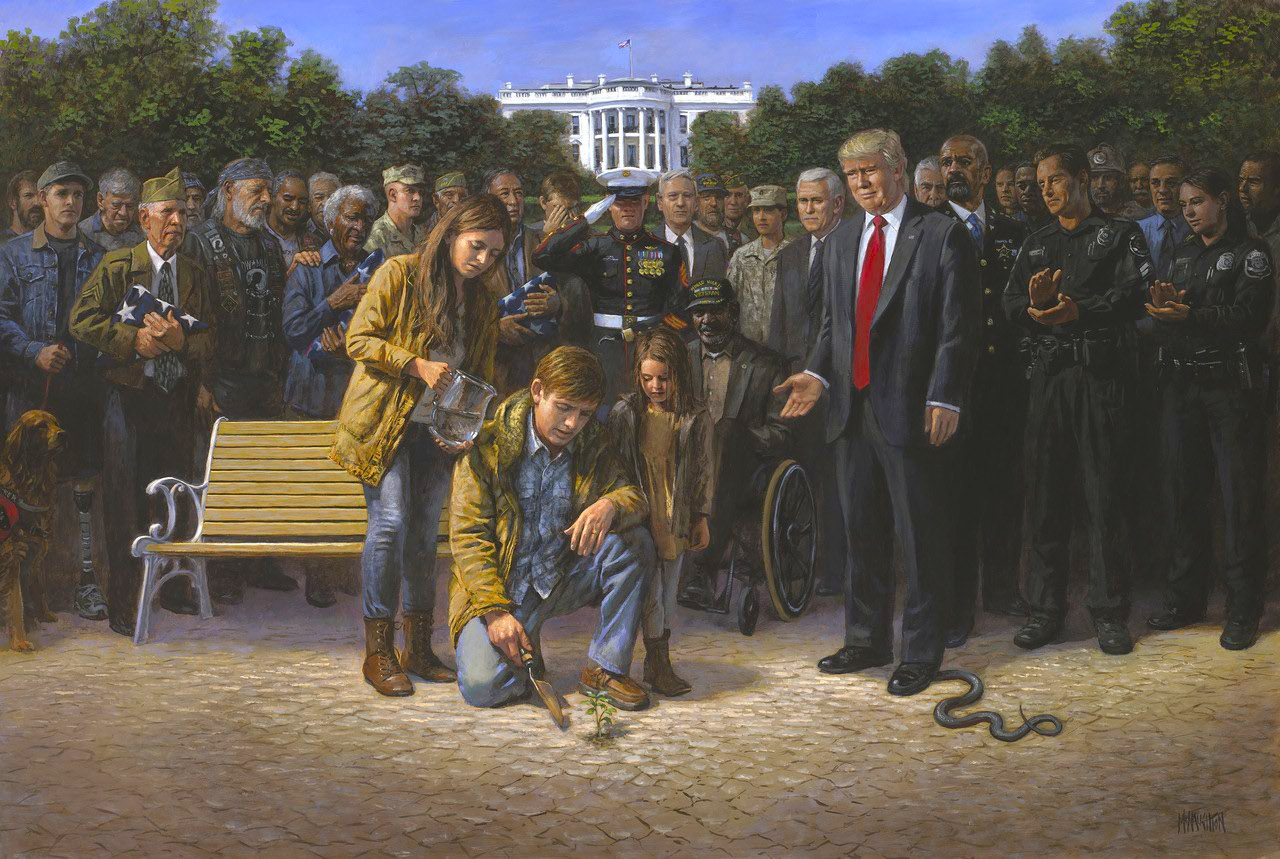
In the presence of Trump, who like the Catholic Madonna tramples the serpent of unbelief beneath his feet, and true American patriots, the once-overlooked and forgotten man plants the delicate sapling of liberty, which, under Trump’s benevolent regime, may now be permitted to sprout and grow into a tree.
Surprisingly, there are many who do not laugh at these cartoonish kitsch disasters. McNaughton’s paintings are celebrated and collectors pay high prices for his “art” and he continues to churn out, in an unbroken stream, his grotesque tributes to Trump and best-selling, sentimental religious paintings.
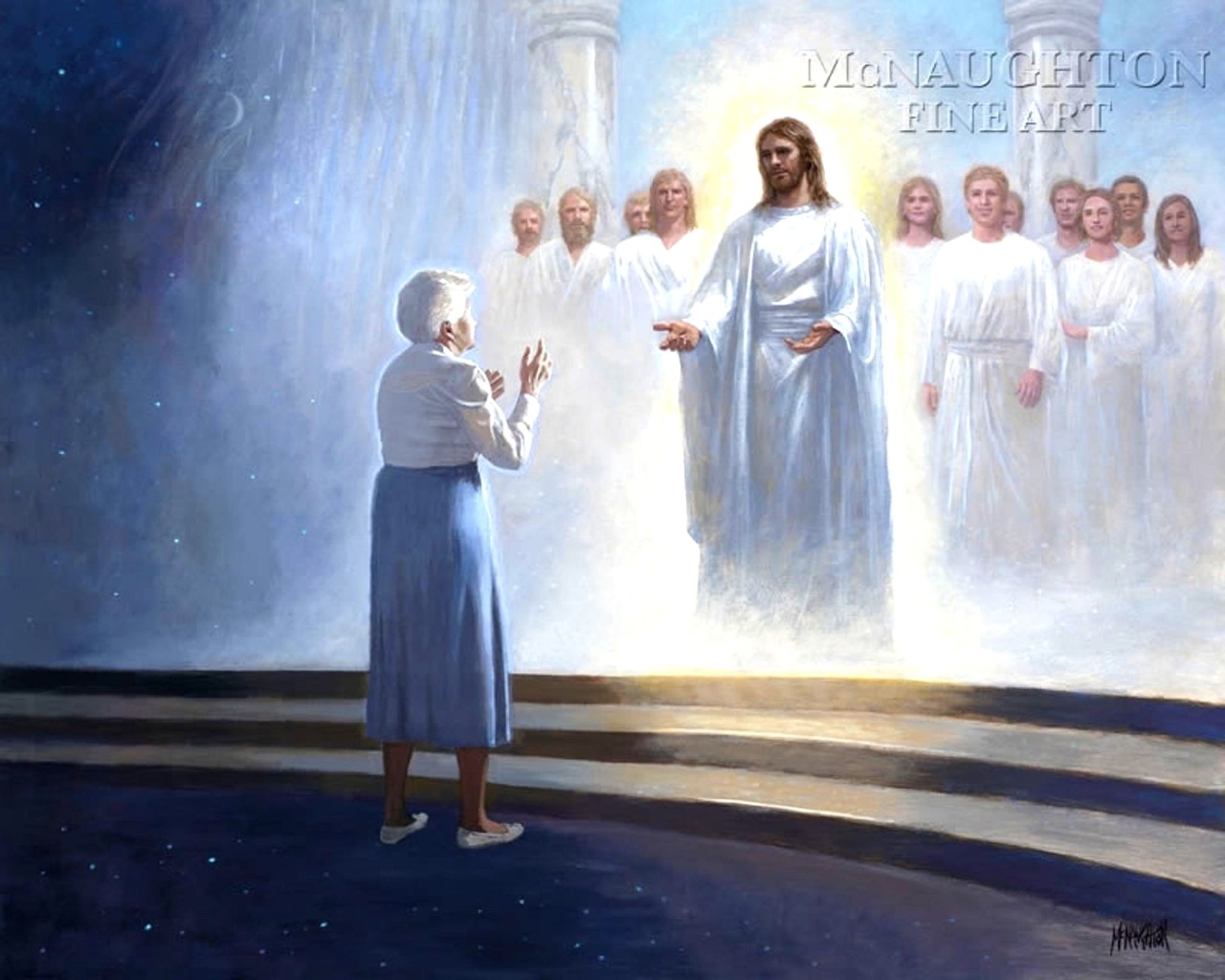
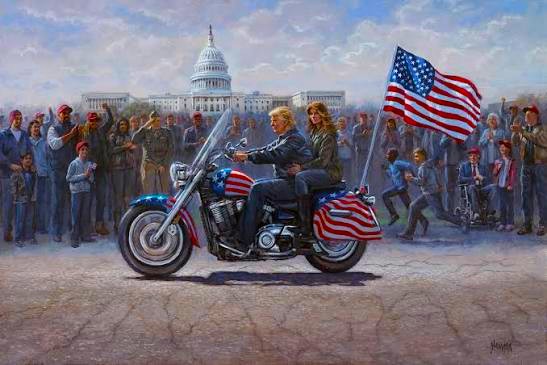
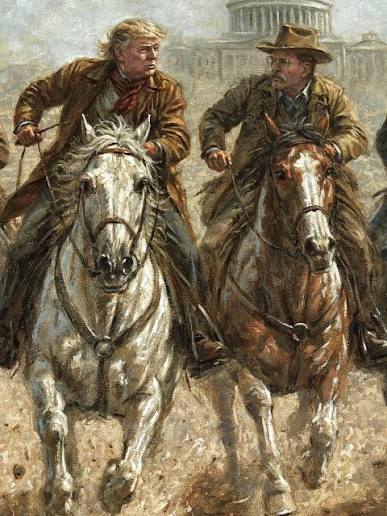
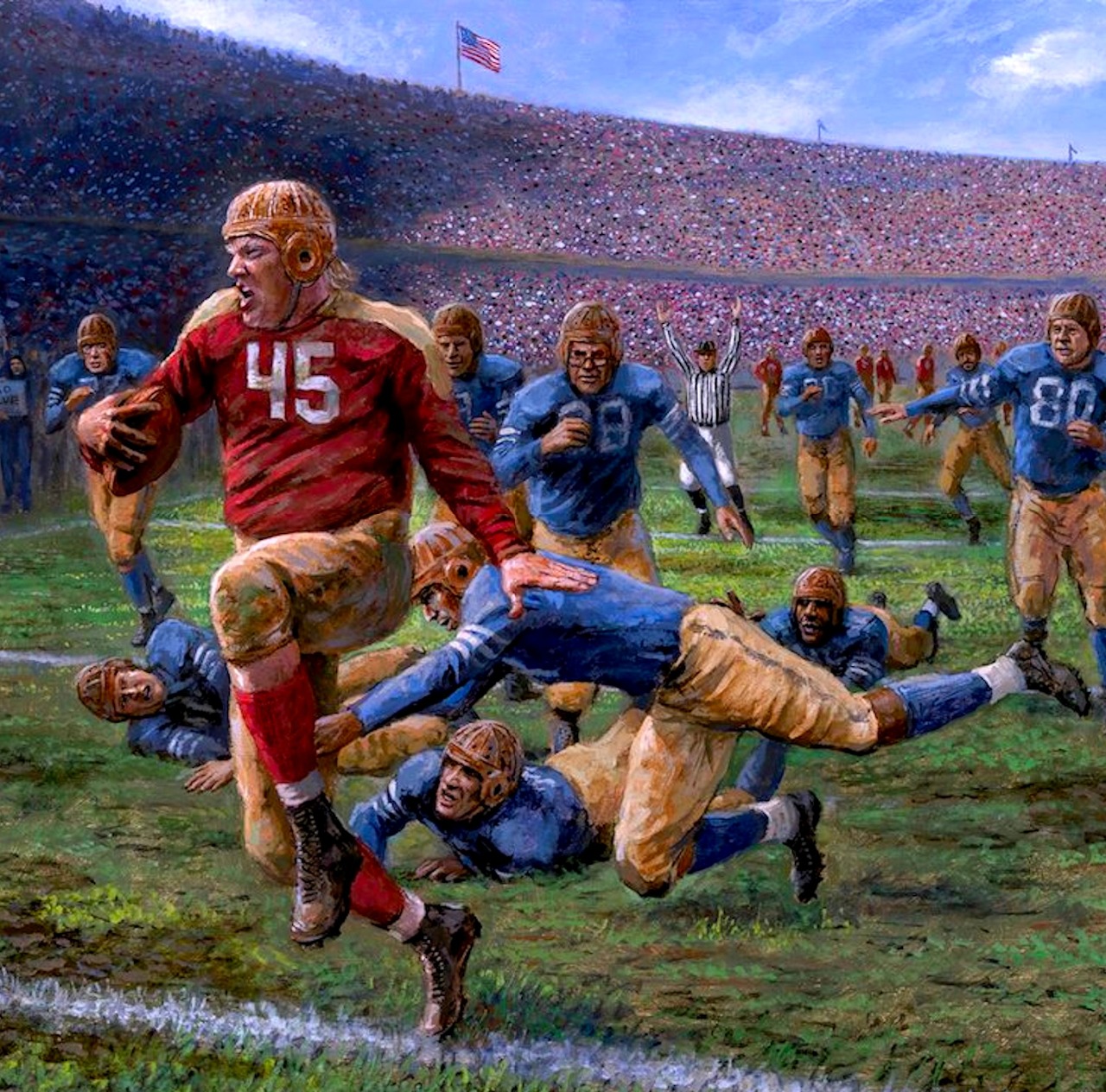
McNaughton’s deified Trump bears little resemblance to his otherwise gentle Jesus. Trump appears more like an action hero, charging forward on horseback alongside the macho president Theodore Roosevelt, or he is depicted as a triumphant American football hero (the number 45 on his jersey alludes to his status as the forty-fifth president of the United States).
If McNaughton were to take it into his head to portray Trump as the Messiah, a scenario not entirely inconceivable, it would likely not resemble the "gentle Jesus" so common in kitsch. Given his previous homages to Trump, McNaughton’s envisioned "Trump-as-Jesus" would more likely be depicted along the lines of the muscle-bound figure created by Stephen Sawyer, an image this artist disseminates through his company, Art 4 God.
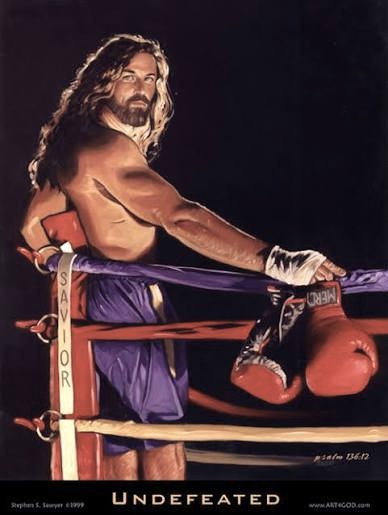
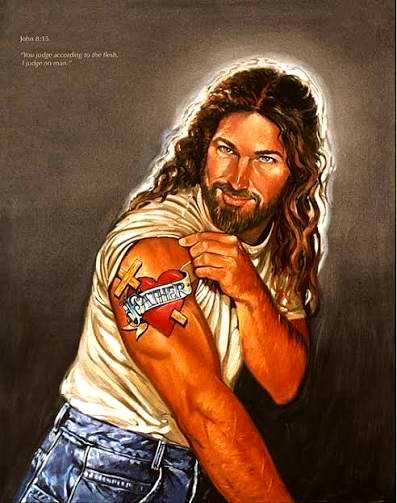
Such a Christ-figure would likely not seem alien to Trump, whose primary interest appears to be professional wrestling. Although he has been asked about his Christian faith on several occasions, he has then claimed that the Bible is his favorite reading material. Strangely enough he has not been able to come up with any quotations, except “thou shalt give life for life, eye for eye." Trump is presumably unaware of the equally aggressive continuation: " tooth for tooth, hand for hand, foot for foot, burning for burning, wound for wound, stripe for stripe.” This passage from Exodus 21:24 is as far removed as one could possibly get from the forgiving, "gentle Jesus." Someone must later have pointed out to him that this was not a particularly suitable quote, as he has since has opted to cite Matthew 5:39: " But I say unto you, that ye resist not evil: but whosoever shall smite thee on thy right cheek, turn to him the other also."
I have nothing against "Christian" art that borders on kitsch. Among others, I have always appreciated the biblical illustrations of William Hole and James Tissot.
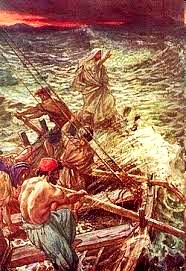
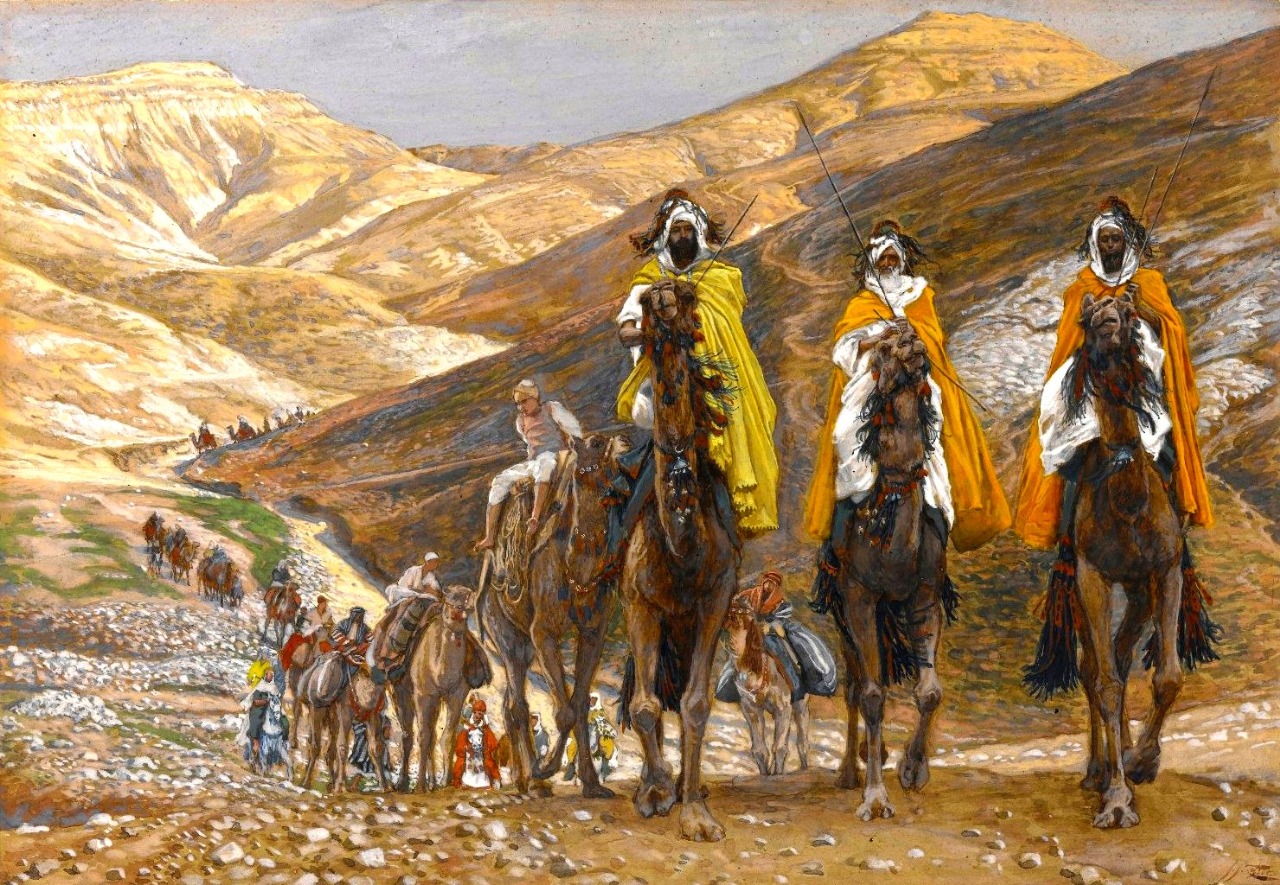
However rooted as he is in the Mormon artistic tradition, McNaughton’s work can be seen as a rather poor offshoot of the far more skilled Arnold Friberg, whose illustrations for the, to put it mildly, tedious and bizarre Book of Mormon are reminiscent of the work of Hole and Tissot.
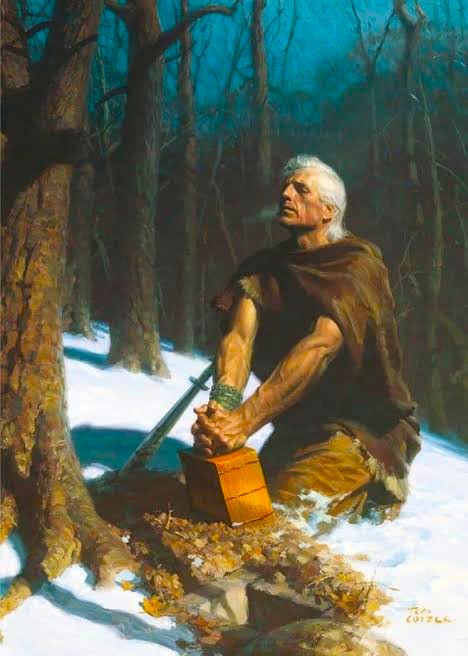
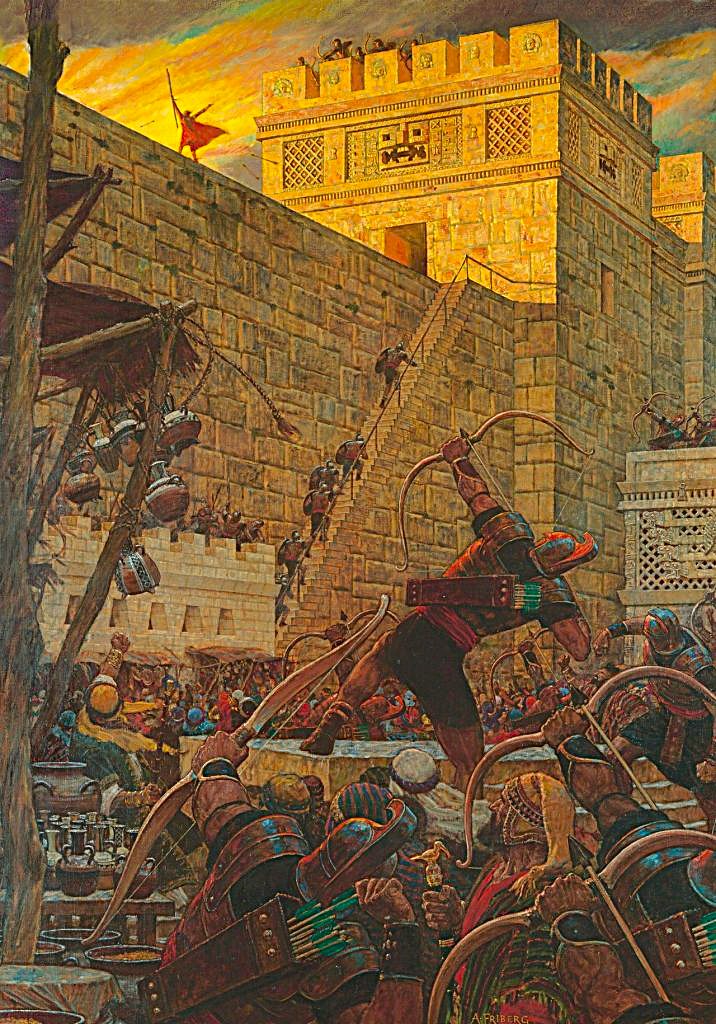
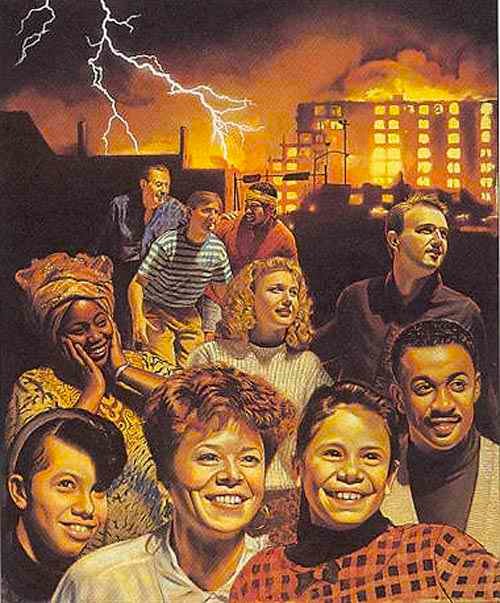
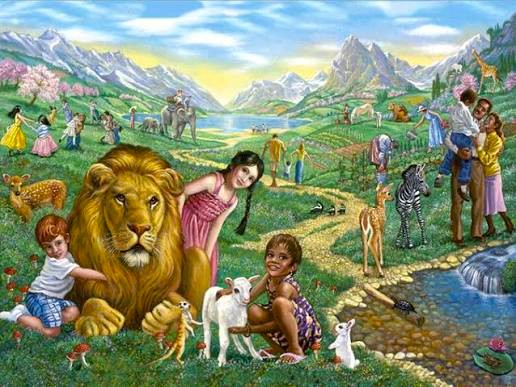
Working in a similar, if somewhat kitschier, style are the anonymous illustrators for the Jehovah’s Witnesses’ publications The Watchtower and Awake!
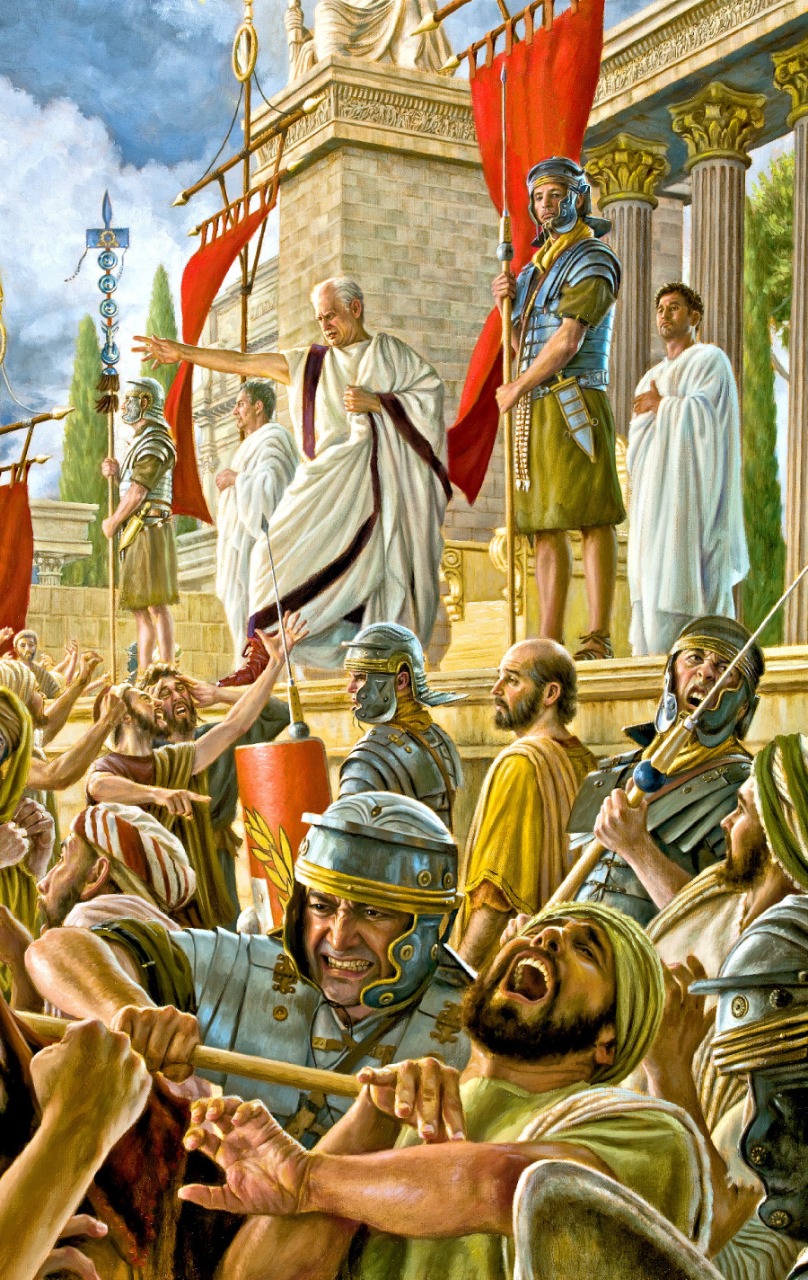
I cannot deny that I find it amusing to flip through those magazines, with their guilelessly garish depictions of the end of the world, the salvation of the chosen ones, and a restored Paradise, where all kinds of animals and all the peoples of the earth live together in an incredible harmony.
Vanessa Horabuena’s visual world is considerably bleaker. She describes herself as a "Christian Worship Painter" and runs a successful business selling reproductions, "hand-embellished by the artist" and bearing her "own personal signature." Horabuena has made a name for herself as a "speed painter," meaning she sometimes completes her paintings in front of an audience in ten minutes.
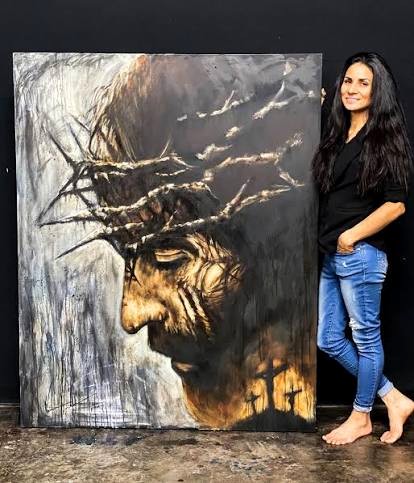
During his lavish New Year’s Eve party at Mar-a-Lago in 2025, Donald Trump introduced Vanessa Horabuena as "one of the greatest painters anywhere,” yet another example of his remarkably poor taste in art, as well as his deficient knowledge. Vanessa carried out her ten-minute painting performance, complete with grand, sweeping gestures. before an audience of glamorous guests and a live television broadcast. Trump then auctioned off the piece to benefit a children’s hospital and the “local sheriff’s office.” It was purchased for $2.7 million.
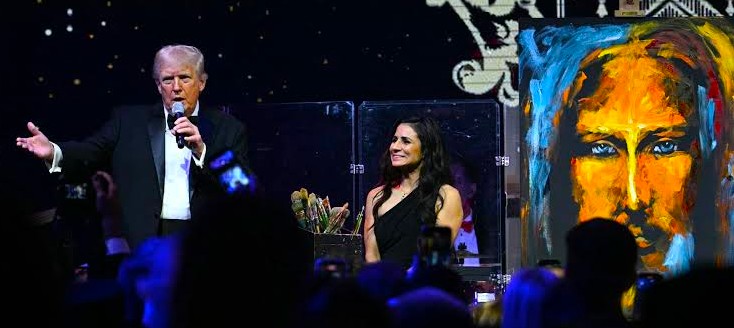
The relationship between Vanessa and Trump began when she personally presented the President with one of her unusually kitschy portraits. On her website, she describes how she created this God-inspired portrait.
Most of this painting was created while I played worship music, prayed for our President, and allowed the Holy Spirit to leave His mark on this work of art. The staff was continually blessed every time they saw it. Hearing their reactions, filled my heart. After working on this piece for two years, it was finally complete, and finally at its destination.
The result of all this effort turned out to be unusually dreadful.
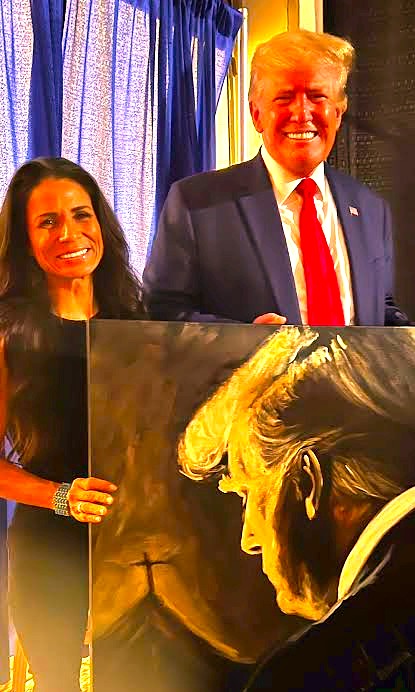
Since then, Vanessa has painted and disseminated a large amount of her kitschy, Trumpist art:
I’m glad we have an honest president, even if he’s a bit rough around the edges […] If the Lord is for us, who can be against us? Let’s keep our President in our prayers, he was certainly called for such a time as this.
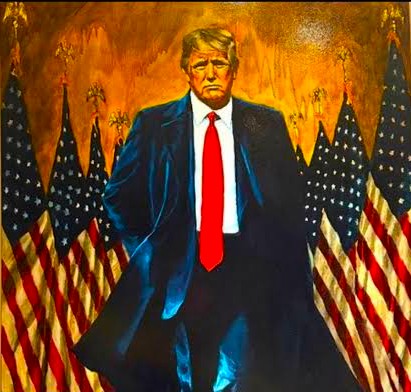
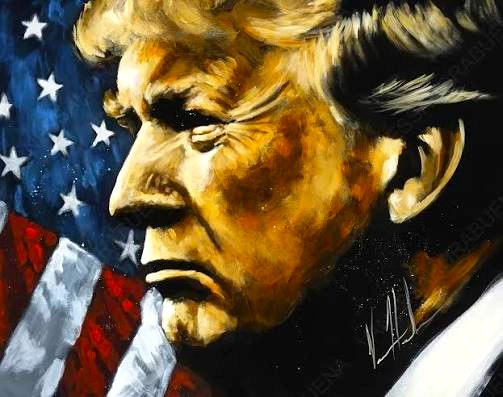
Religious kitsch is abundant worldwide, even within Sunni Islam, which generally adheres to aniconism, a prohibition on the depiction of living beings. In contrast, no such restrictions exist within other branches of Islam, such as Shia Islam, which points out that the Quran contains no explicit ban on the creation of images.
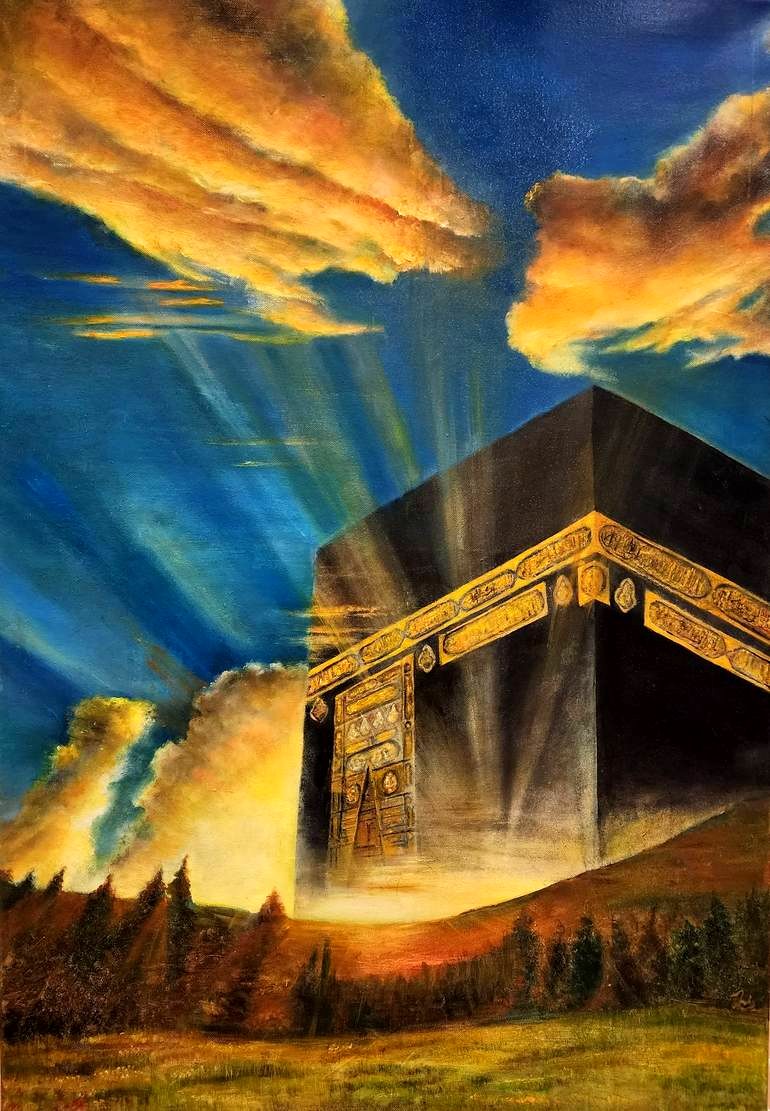
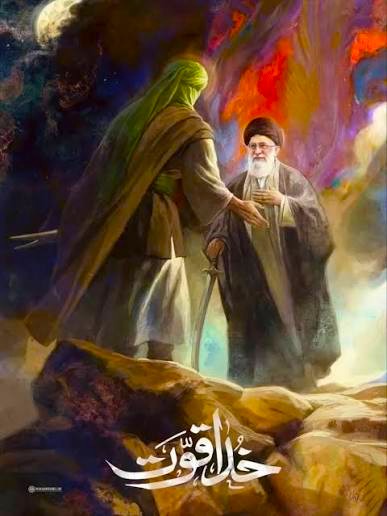
In Hinduism, religious kitsch, manifested through mass-produced art, has become ubiquitous.
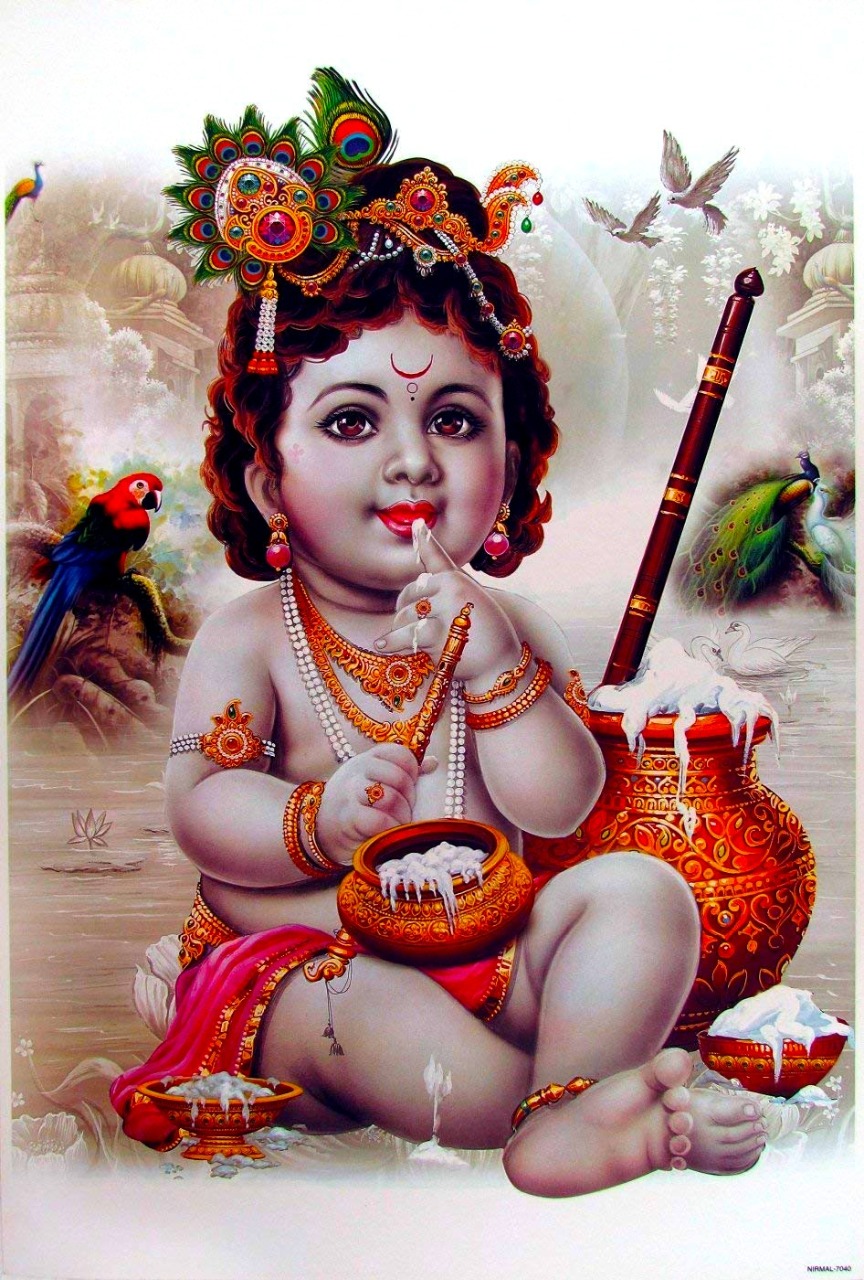
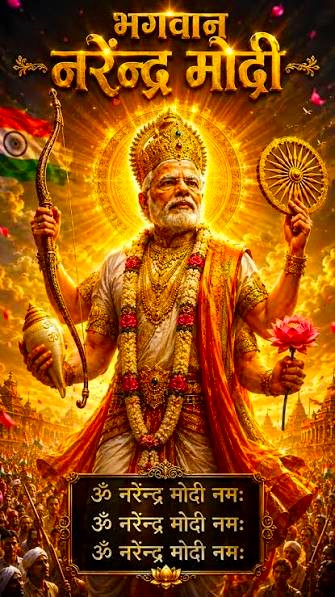
In this context, as the case is among many other regimes, there is a tendency to exalt political leaders as divinely gifted figures. Such men (rarely women) are frequently portrayed alongside religious artifacts. The increasingly self-admiring Narendra Modi has even been depicted, with the aid of AI, as an avatar of the god Vishnu. More specifically, he is portrayed as Kalki, the god’s tenth and final incarnation, destined to bring an end to the current era, the Kali Yuga, a time defined by darkness, confusion, unrest, and destruction.
Kitsch is everywhere. In Mao’s Communist People’s Republic, it flourished in the form of cheerful, well-fed babies enjoying the fruits of prosperity – toys, model rockets, and cameras – while muscular, heroic workers rushed to defend the nation.
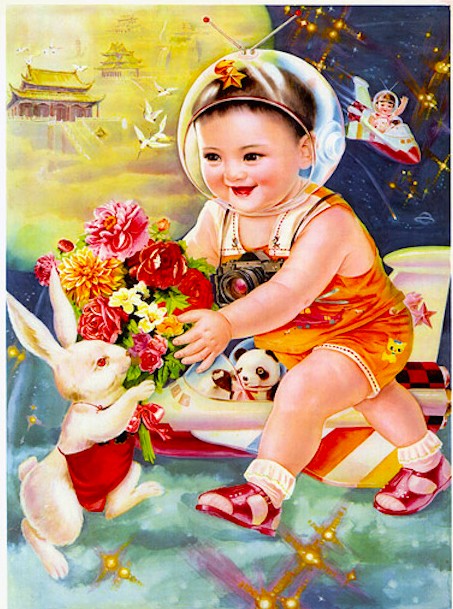
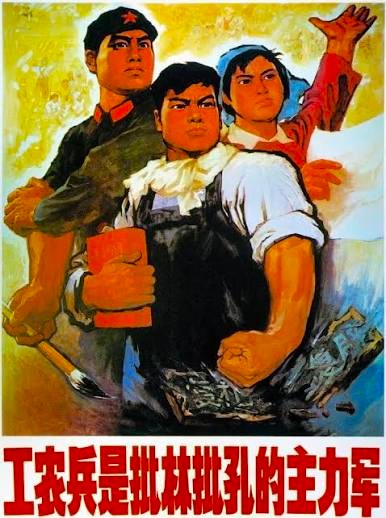
Like all dictators, Mao was portrayed as a leader who loved children and remained close to his beloved people.
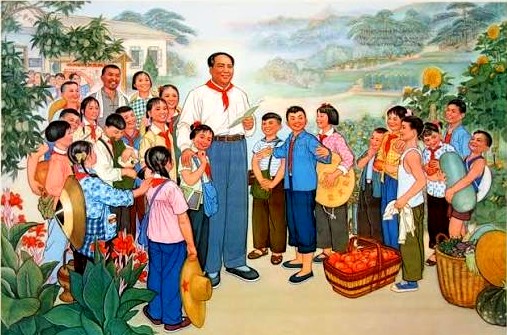
Soviet propaganda took a different form, yet it was no less kitschy than its Chinese counterparts. Here, too, one finds happy children and a leader who dotes on them.
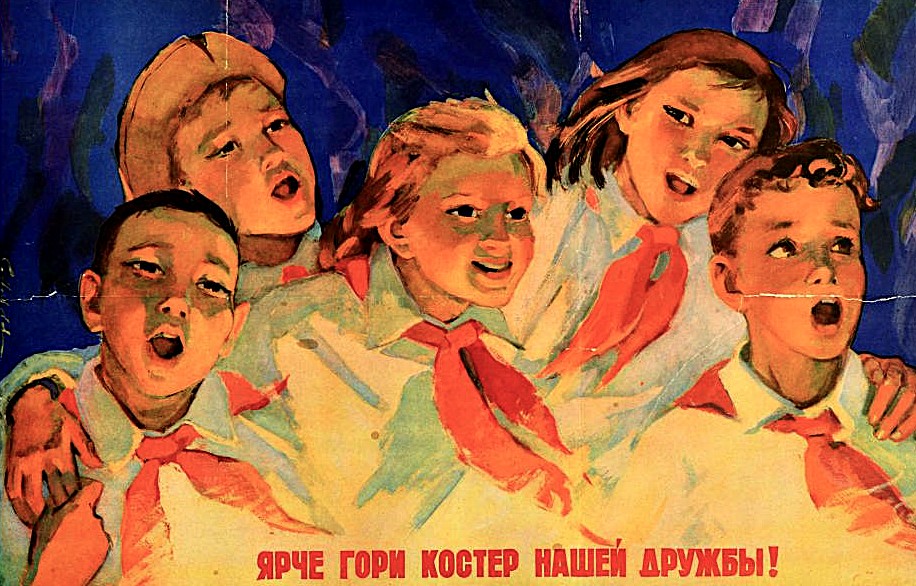
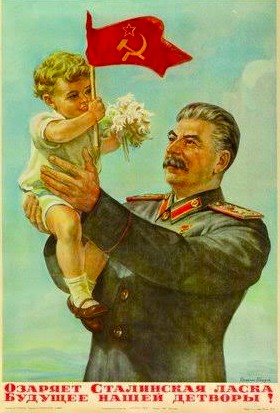
And, quite naturally, the usual super-worker hunks.
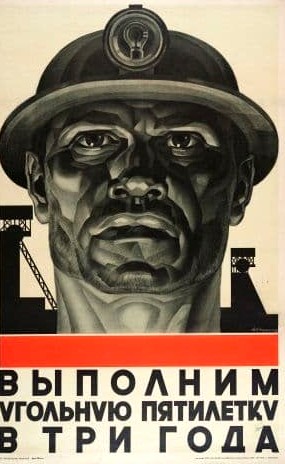
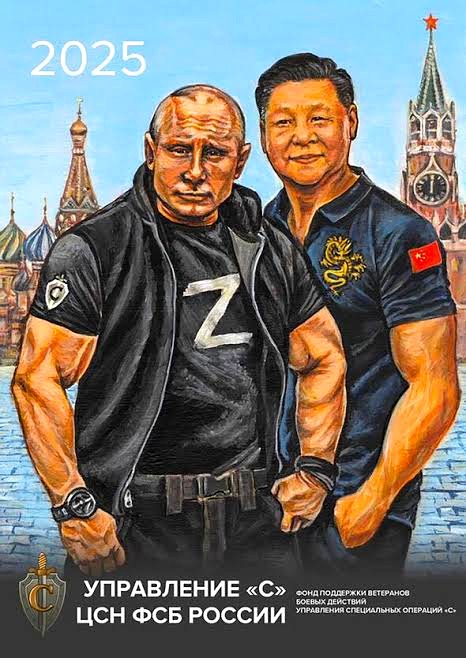
This tough-guy style recurs in contemporary Russian propaganda kitsch – for instance, in a calendar from the FSB, successor of the KGB, where a muscular Putin, flanked by Xi Jinping, looks more like a burly thug than the Supreme War Leader and Chairman of the Russian State Council. The same calendar also featured sentimental, religious overtones.
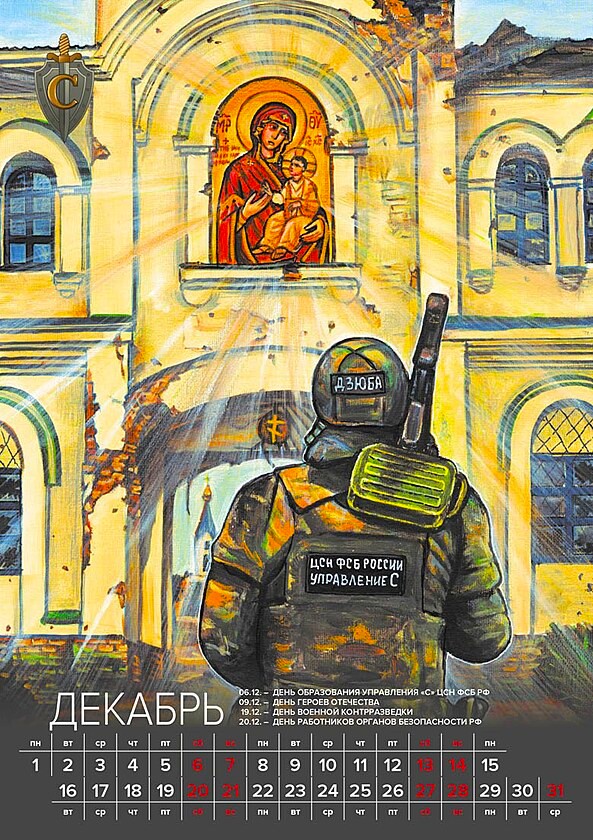
Naturally, several Chinese artists grew weary of communist kitsch and responded by using various means to parody and criticise it.
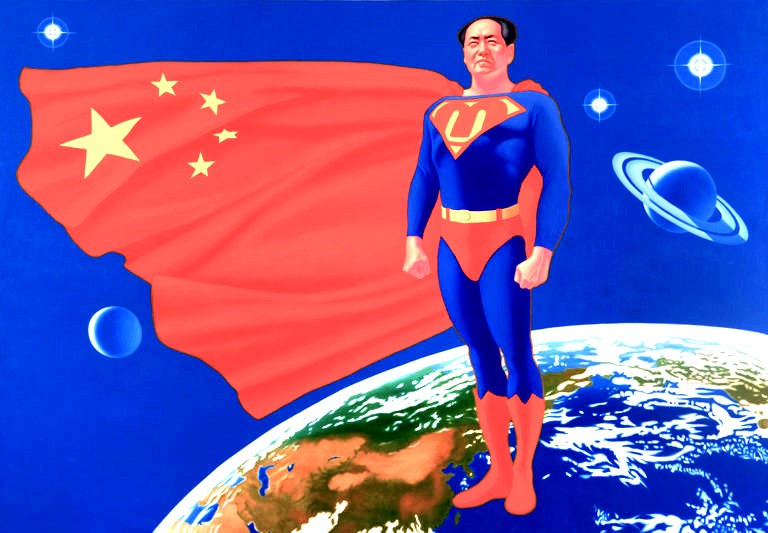
For a time, Chinese art and literature became filled with sharp criticism and satire regarding the harsh years of the Cultural Revolution and the brutal repression that followed a brief period of relative freedom. The inspiration they drew from pop art and political kitsch is often evident.
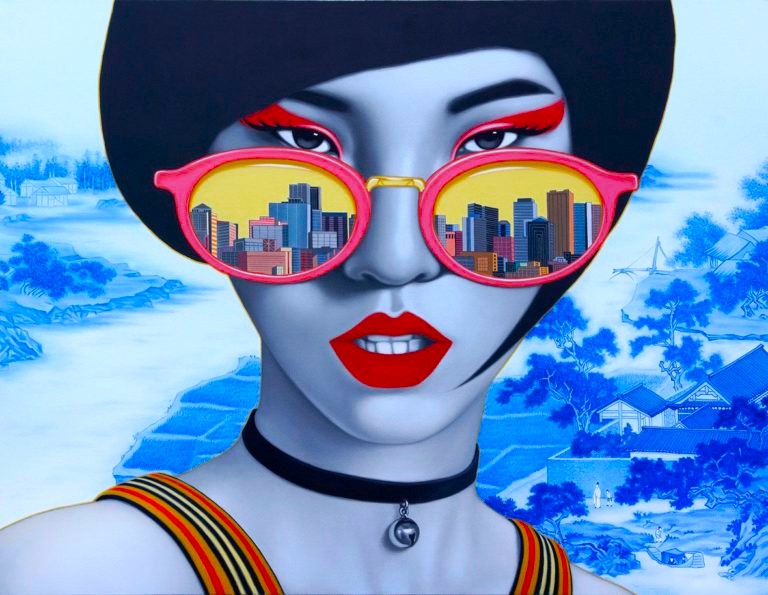
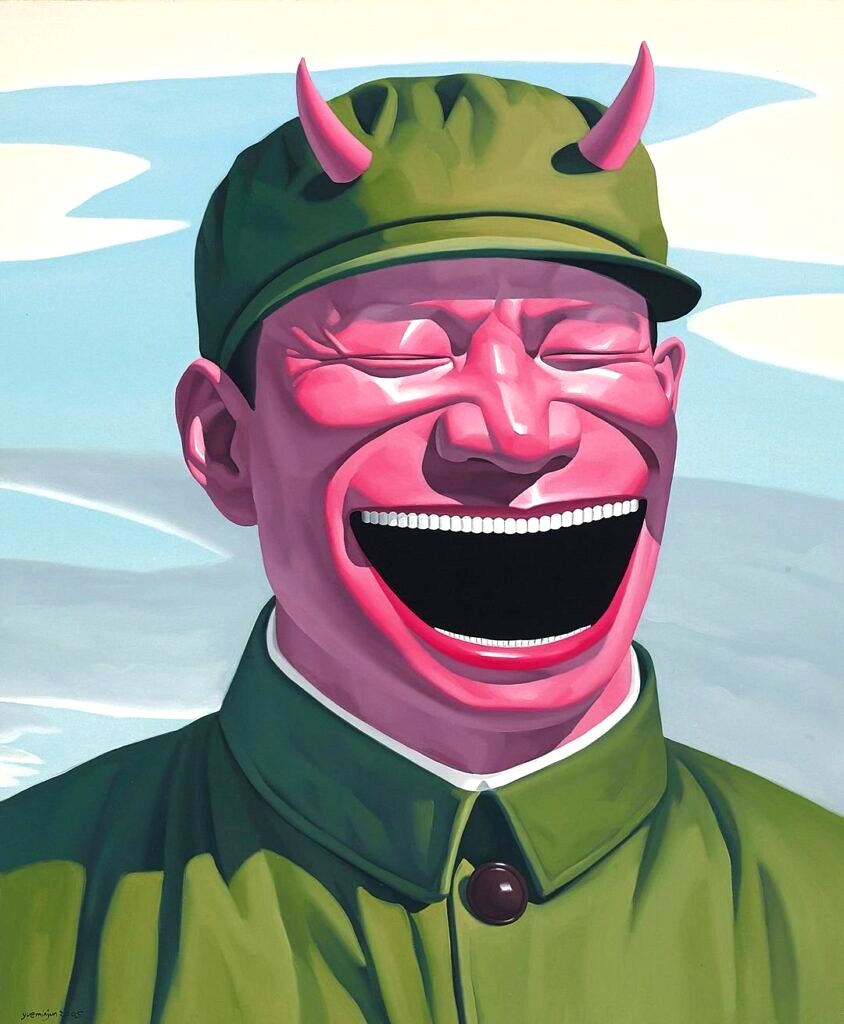
Of course, were these endeavours not at all popular with the authoritarian Xi Jinping. In famous speech, he urged China’s artists not to become "slaves to the market forces" or lose their course wile becoming overwhelmed by greed. He argued that their art should foster patriotism, convey an accurate vision of Chinese history and culture, and reflect "core socialist values." Chinese communism promotes traditional Chinese culture, which constitutes the "soul" of the nation and the ideological foundation of the Party.
Under the aegis of Xi Jinping, state control and censorship, spanning film, literature, the visual arts, and digital platforms, have intensified. Political kitsch has made a comeback in the public sphere, while the avant-garde, modernism, and all forms of political dissent are once again being punished. Meanwhile, the benevolent face of the "Great Leader" once again shines over the nation.
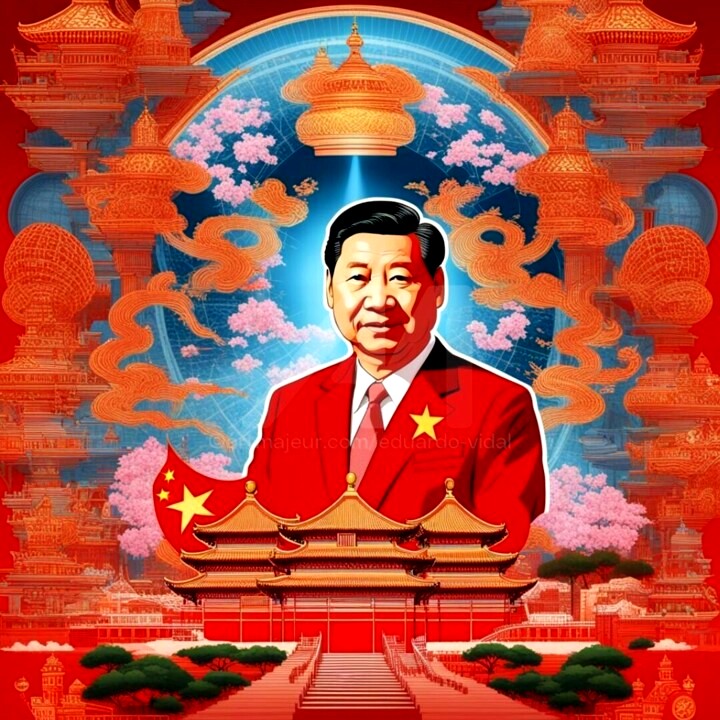
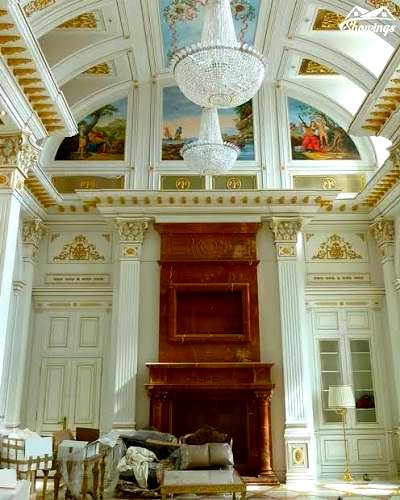
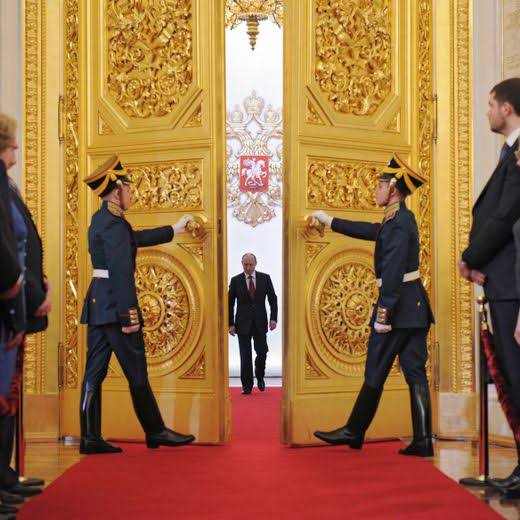
Putin’s newly built palace in Gelendzhik, on the shores of the Black Sea, and his renovations within the Kreml. are likely stir the envy of Trump, given their lavish abundance of gold and marble, on which the Russian autocrat has managed to spend astronomical sums, free as he is from any inconvenient scrutiny from press and opposition.
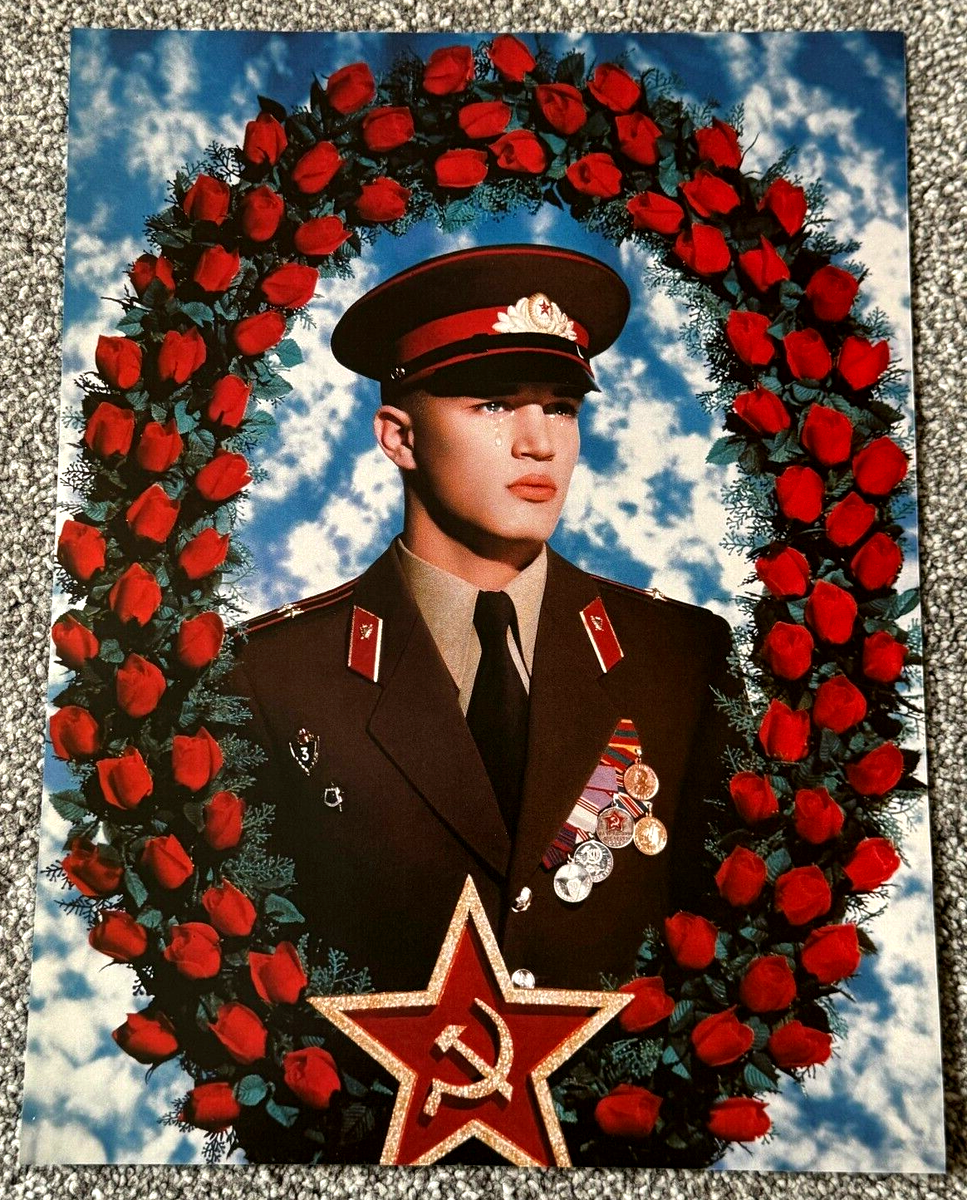
Soviet propaganda has also been subjected to parodies ridiculing its political kitsch. A playful mockery of patriotic schmaltz. excessive sentimentality, can be seen in the work of the French gay artist duo Pierre Commoy and Gilles Blanchard – a depiction of a weeping Russian soldier titled Le Petit Communiste.
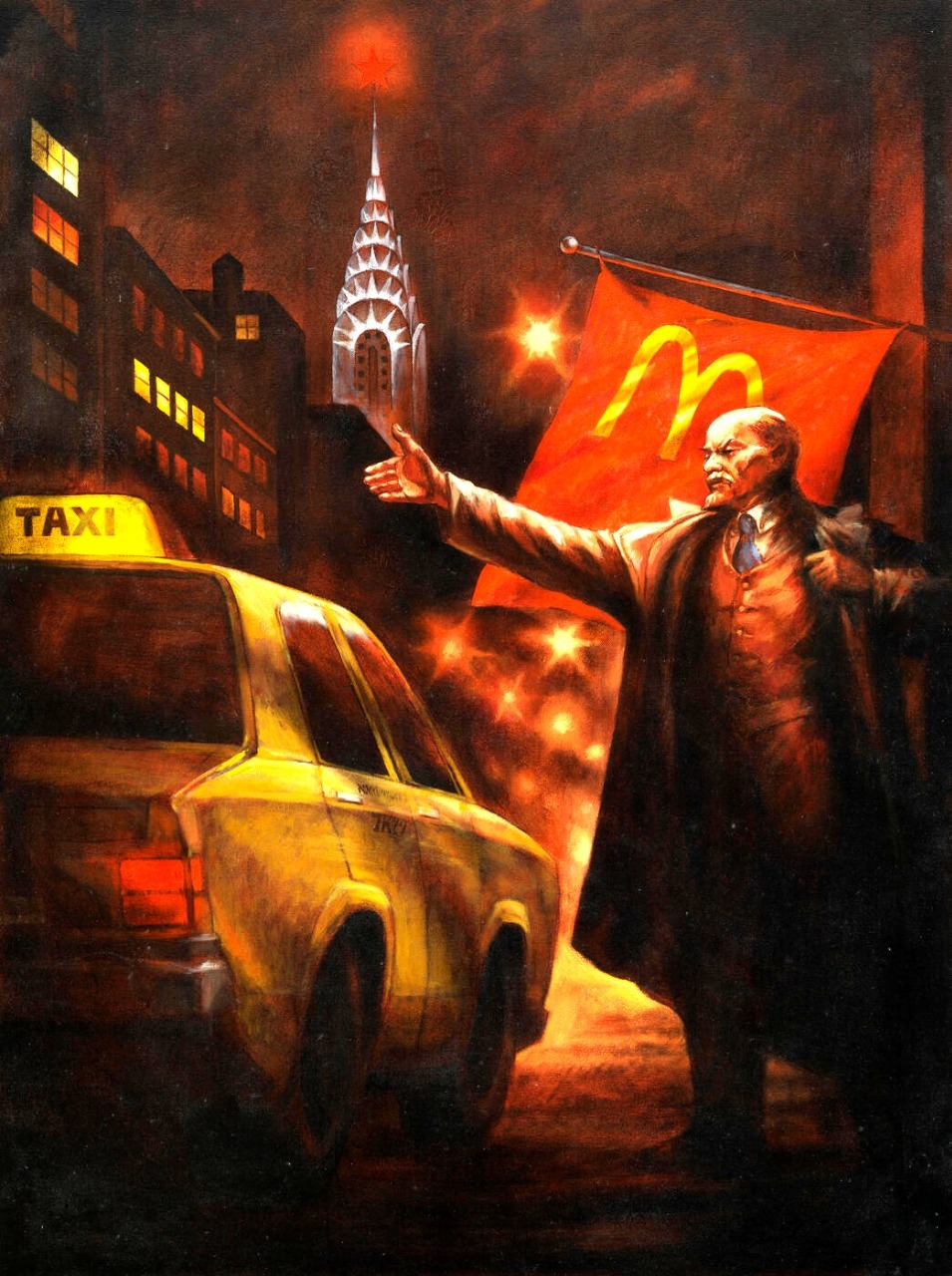
During their time at an art institute in Moscow, a clever collaboration began between Daniel Melamid and Vitaly Komar, when they began creating parodies of Soviet academic art, infused with elements of Pop Art. In 1977, they emigrated to New York, where they produced a large body of work under the logo Komar and Melamid. They parted ways in 2003.
In one of their pieces, they portrayed themselves as small, yet adult, Communist Pioneers saluting a bust of Stalin. For a cover of The New Yorker, Komar and Melamid parodied the common gesture of the "Leninesque" persona embodied on thousands of sculptures of the leader. On a street in Manhattan, they transformed a Communist banner into an advertisement for McDonald’s, in front of which the Communist patriarch is shown hailing a taxi.
.jpeg)
Via the internet, Komar and Melamid distributed a questionnaire worldwide to determine what might constitute the "most wanted landscape" in various specific countries. Surprisingly, they received a large number of responses, which they used to compile Most Wanted Landscapes for several nations, among them for example Turkey, China, Iceland, Finland, and Denmark. Based on the received responses, the artists created kitschy interpretations Shown below is the “People’s Choice" for the Most Wanted Painting in the United States.
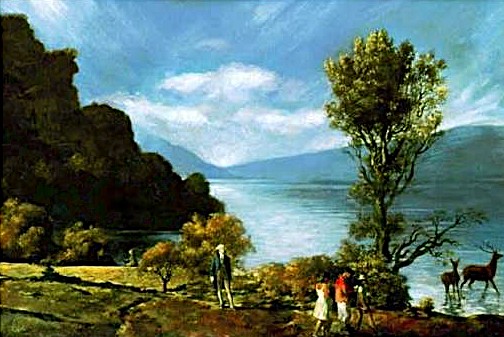
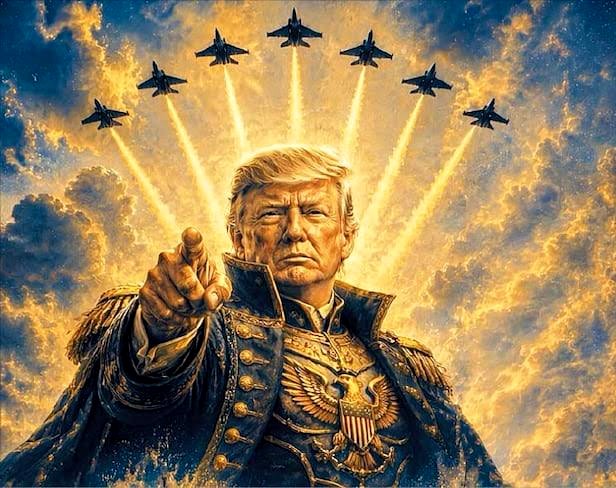
This was before the era of AI. Nowadays, anyone can easily generate their own most desired image. Naturally, these pictures tend to be "realistic" and generally lean toward the kitschy. Particularly bizarre are the images produced by Trump’s team for his website, where America’s penchant for the worst kind of political kitsch is given free rein, such as an image of Trump as a general from the American Revolutionary War, set against a backdrop of fighter jets.
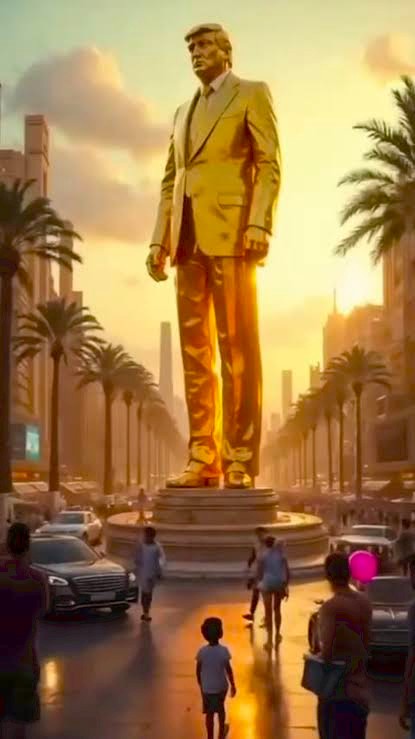
One of the most unsettling features is an AI-generated video clip in which Trump and Netanyahu are portrayed as the liberators of Gaza and the architects of a luxurious Wonderland, complete with a colossal, gold-plated statue of Trump.
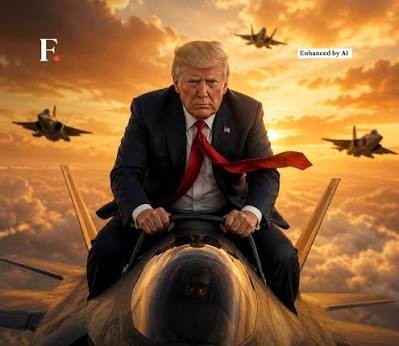
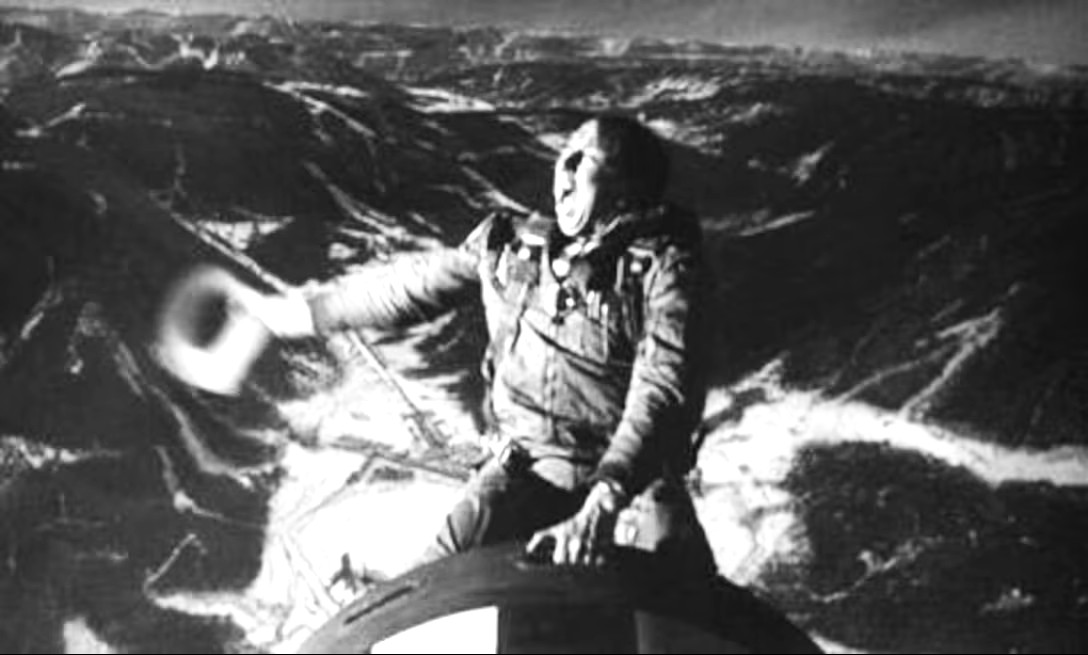
Among other imagery of the site, we find Trump straddling a bomber plane headed toward Iran. It is likely that the generally ill-informed Trump is unaware of the unpleasant associations this image evokes to the completely unhinged Major T.J. King Kong riding an atomic bomb toward his own, and everyone else’s, destruction in the iconic final scene of Stanley Kubrick’s Dr. Strangelove.
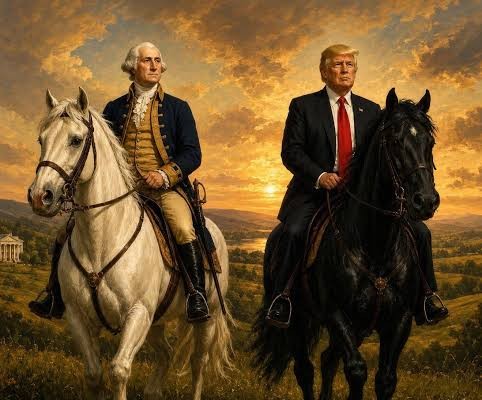
We are presented with an image in which Trump, at daybreak, comes riding toward us alongside George Washington. Although Trump, in several of the AI-generated images he frequently posts on his website, depicts himself on horseback, there is no evidence to suggest that he actually knows how to ride. In fact, he has on a few occasions expressed a certain aversion to animals; unlike several of his predecessors in the presidency, he has never owned a dog or a cat.
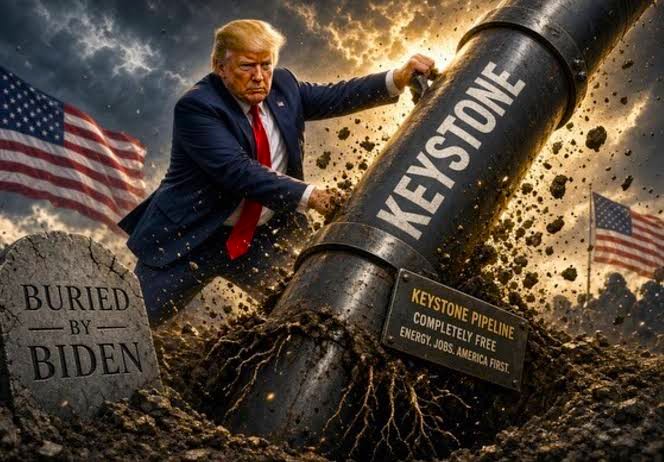
Another AI-generated image on Trump’s website features him forcefully tearing the Keystone pipeline out of the ground, where it had been “buried” by Biden. In reality, the completed sections of this controversial pipeline – intended to transport oil from Alaska, through Canada, and into the rest of the United States – have repeatedly been shut down due to major, environmentally hazardous leaks. At times, work has also been halted because of the project’s environmental risks and intractable land disputes. The “phase four” that Trump has promised to open has not yet been built.
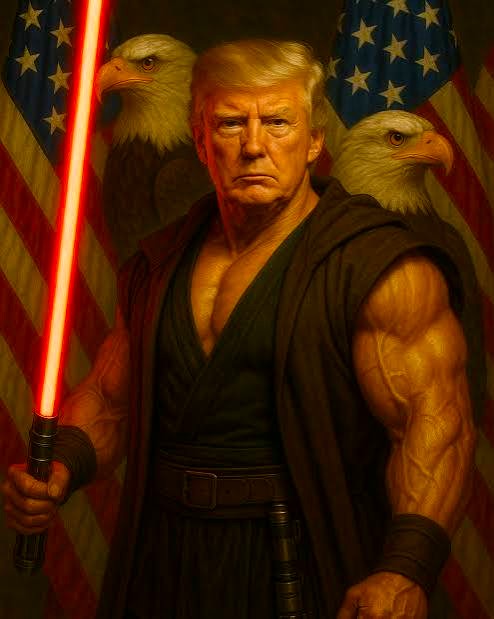
The pale and flabby Trump, who loves combat sports, likes being portrayed as a muscle-bound superhero, as seen here below, where he poses as a Jedi warrior from Star Wars.
He also had the idea to have himself depicted as Atlas, bearing the entire earth globe on his shoulders.
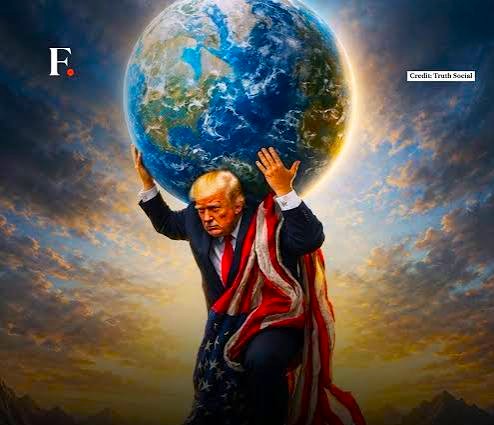
Throughout the scandalously initiated and poorly managed war against Iran, which evidently cost his party its majority in both the House and the Senate, Trump has continued, undeterred, to portray himself as a victor. As seen here, where he has lowered the Iranian flag and is hoisting the Stars and Stripes aboard a vessel passing through the Strait of Hormuz.

It is somewhat unclear what Trump hopes to gain from these laughably pathetic AI-generated images of himself in various heroic roles, other, perhaps, than to boost his already inflated ego. They are, without a doubt, an utterly deranged display of political kitsch, the likes of which one might only find in present or past totalitarian states.
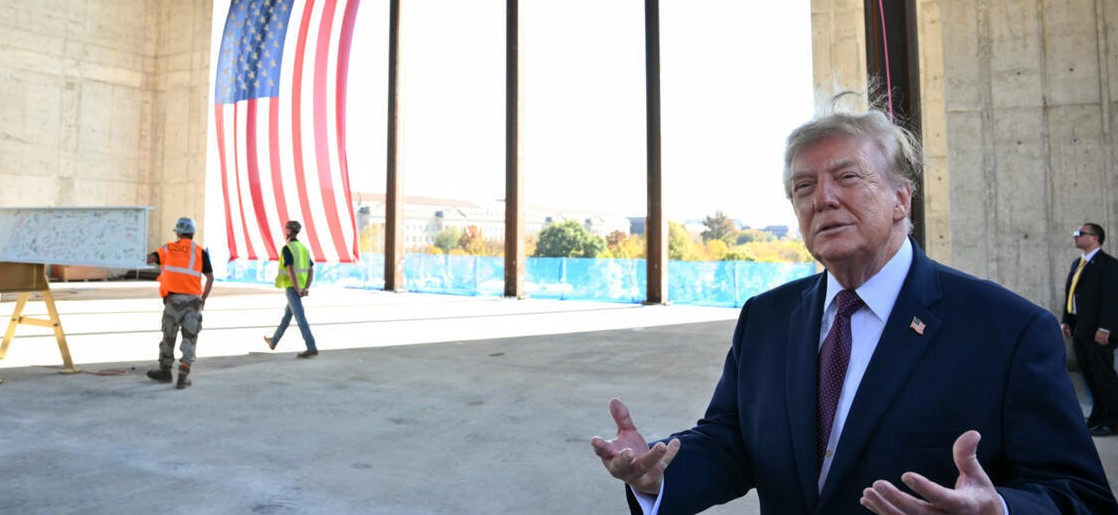
It becomes almost tragic when, the day after the midterm elections, which proved so catastrophic for him, one is confronted with this solitary, aging man facing the press in his half-finished "ballroom." With its monumental scale, gold, and marble, the space is beginning to resemble a mausoleum dedicated to himself and his disastrous presidency.
Instead of addressing the factors that brought down the Republican Party, which had so far naively and foolishly has staked its entire reputation on this political oaf, Trump spoke only of the magnificent structure he currently is erecting. It appears as if he is desperately clinging to the very thing that, long ago, once saved him from being a bankrupt wretch on the brink of ruin. The Potemkin scenery that transformed him into a reputable and respected businessman. A PR chimera built out of gold. all for the sake of money and prestige. Without a doubt a monumental form of kitsch.
Benjamin, Walter (2025) One-Way Street and Other Writings. London: Penguin Modern Classics. Camfield, William (1979) Francis Picabia: His Art, Life and Times. Princeton: Princeton University Press. Greenberg, Clement (1971) Art and Culture: Critical Essays. Boston: Beacon Press. Gualdoni, Flaminio (2008) Kitsch. Milano: Skira. Horabuena, Vanessa https://vanessahorabuena.com/ Malaysia Learning Hub (2006) ”Kitsch Meaning: Definition, Examples, History & How to Use It”. https://www.read.com.my/vocabulary/kitsch-meaning/. Priutt, Bill (2024) ”The Donald Trump I Saw on The Apprentice”, in Slate, May 30. Sontag, Susan (2025) Against Interpretation and Other Essays. London: Penguin Modern Classics. York, Peter (2006) Dictator Style: Lifestyles of the World's Most Colorful Despots. San Francisco: Chronicle Books.